
What Does ELI Mean in Grade 23 Titanium Foil?
- Grade 23 ELI Titanium Foil
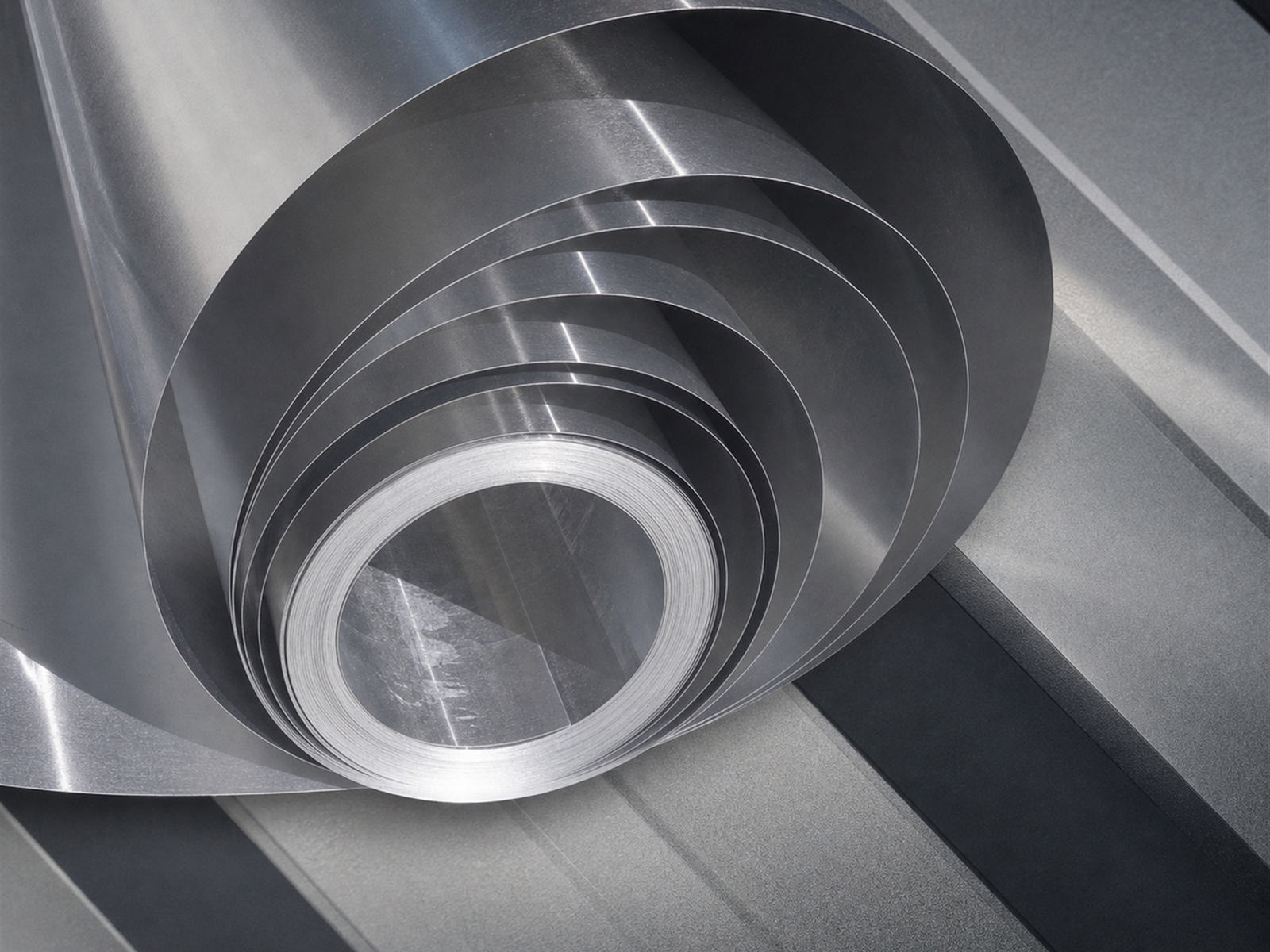
ELI means extra-low interstitial. This guide explains how limits on elements such as oxygen relate to Ti-6Al-4V material behavior, and why a Grade 23 designation and an ASTM F136 purchase specification should be checked separately. View related foil specifications.
What Interstitial Elements Are
Oxygen, nitrogen, carbon and hydrogen are the four interstitial elements in titanium — atoms small enough to sit between the lattice sites of the hexagonal α phase rather than substituting for titanium. Because they distort the lattice, they harden and strengthen the metal, which is why the entire commercially pure grade ladder (Grade 1 → 4) is built from oxygen. The cost is ductility and toughness: interstitials concentrate strain, blunt slip and make the material notch-sensitive.
Grade 23 ELI vs Grade 5: The Numbered Difference
Element (max %) | Grade 5 | Grade 23 ELI | Effect of the tighter limit |
Oxygen (O) | 0.20 | 0.13 | Higher toughness, better cryogenic ductility |
Iron (Fe) | 0.40 | 0.25 | Cleaner microstructure, better fatigue behavior |
Hydrogen (H) | 0.015 | 0.012 | Lower hydride and delayed-cracking risk |
Carbon (C) / Nitrogen (N) | 0.08 / 0.05 | 0.08 / 0.05 | Unchanged |
Table 1 — The ELI budget: oxygen, iron and hydrogen carry the property differences.
The Properties ELI Buys
- Fracture toughness — typical annealed values move from roughly 55–65 MPa·√m (Grade 5) toward 75–95 MPa·√m (ELI) in literature data, per heat and product form;
- Cryogenic ductility — ELI material keeps usable ductility at temperatures where standard Ti-6Al-4V embrittles, the reason it serves in liquid-hydrogen systems;
- Fatigue crack growth — slower growth and higher threshold in damage-tolerant design;
- Weld ductility — as-welded joints retain more toughness without stress relief;
- Biocompatibility — the cleaner chemistry is the implant-grade profile of ASTM F136.
What ELI Does Not Change
Compare the requirements for the specified standard, edition, thickness and condition. Differences between published minimums do not quantify the effect of interstitial content on a particular heat.
ELI in Service: Where the Chemistry Is Specified
Application | Typical thickness | Process | Key requirement |
Pacemaker / defibrillator housings | 0.2–0.4 mm | Deep drawing + laser seal welding | Biocompatibility, EMI shielding, hermetic closure |
Medical device housings and parts | 0.2–0.5 mm | Stamping / deep drawing | Biocompatible, non-magnetic, sterilization-resistant |
Bone plates / internal fixation | 0.6–1.0 mm | Stamping + machining + surface treatment | Elastic modulus near bone, non-magnetic, biocompatible |
Dental implants and abutments | 0.5–1.0 mm | Turning + threading + sandblasting/acid-etching | Osseointegration, saliva corrosion resistance, non-toxic |
Table 2 — The ELI application set: implant housings, surgical parts, bone plates and dental stock.
Standards and Naming Variants
ASTM B265 Grade 23 (Titanium Valley material documentation) uses UNS R56407. ASTM F136 (Titanium Valley material documentation) uses UNS R56401. Specify the required edition, product form and acceptance requirements on the order.
Verifying ELI on the Certificate
Three fields decide it: oxygen ≤ 0.13%, iron ≤ 0.25% and hydrogen ≤ 0.012% — plus the heat number, tensile/elongation for the correct thickness band, condition and the standard edition. A certificate that quotes Grade 5 limits is not an ELI certificate regardless of its header, and chemistry that merely “meets F136 chemistry” without measured O and Fe values deserves a query. Custom size, condition, tolerance and documentation can be reviewed to the purchase specification.
FAQ
(1) Is Grade 23 ELI weaker than Grade 5?
Compare the requirements for the specified standard, edition, thickness and condition. Differences between published minimums do not quantify the effect of interstitial content on a particular heat.
(2) Does ELI chemistry cost more?
Yes — the tighter interstitial control demands cleaner melting practice (double or triple vacuum arc remelting is standard) and more chemistry testing, which is reflected in price and lead time.
(3) Can a Grade 5 part be upgraded to Grade 23 foil?
Often yes: geometry, processing and corrosion behavior carry over. Re-verify strength margins against the slightly lower minimums and update the drawing, standard callouts and supplier documentation.
(4) How do I verify ELI chemistry on the certificate?
Read the oxygen and iron values — ELI must show O ≤ 0.13% and Fe ≤ 0.25%, plus H ≤ 0.012%. A certificate that quotes Grade 5 limits is not an ELI certificate regardless of the header.
(5) What thicknesses are available in Grade 23 ELI foil?
Implant and aerospace gauges are quoted case by case within the standard 0.02–1.0 mm capability band; gauge, tolerance, condition and documentation are confirmed at order review. Custom size, condition, tolerance and documentation can be reviewed to the purchase specification.
(6) Why is hydrogen limited more tightly in ELI material?
Hydrogen embrittles titanium through hydride formation; the tighter cap protects the toughness and fatigue margins that ELI chemistry exists to provide.
(7) Does ELI anodize like Grade 5?
Yes — color and bond-prep anodizing behave the same across the Ti-6Al-4V family; the cleaner chemistry gives a slightly more uniform oxide for critical bonding work.
(8) Which melting route delivers ELI levels?
Double or triple vacuum arc remelting with tight interstitial control is the standard practice; the melting route should be part of the purchase specification for critical orders.
Related Resources and Inquiry
See the ASTM F136 Gr23 ELI foil page, the Grade 5 foil page for comparison, or send your specification.
Baoji Titanium Valley Titanium Nickel Zirconium Material Processing Co., Ltd. operates a 750 mm 20-high titanium foil line (3, 000 t/yr, ISO 9001 / ISO 13485) covering the full 0.02–1.0 mm range with etching, stamping and welding compatibility. Send your specification to sales@titaniumvalleys.com — Custom size, condition, tolerance and documentation can be reviewed to the purchase specification.
References
1. ASTM B265, Standard Specification for Titanium and Titanium Alloy Strip, Sheet, and Plate.
2. ASTM F136, Standard Specification for Wrought Titanium-6Aluminum-4Vanadium ELI Alloy for Surgical Implant Applications.
3. ASTM E8/E8M, Standard Test Methods for Tension Testing of Metallic Materials.
4. SAE AMS 4907, Titanium Alloy Sheet, Strip, and Plate, 6Al-4V, Extra Low Interstitial, Annealed.
6. Baoji Titanium Valley: 0.02–1.0 mm Titanium and Titanium Alloy Strip and Foil — Application Introduction (internal application deck).
7. Titanium Valley product data: ASTM F136 Gr5 ELI (Gr23) Titanium Foil product page (titaniumvalleys.com).
This article is a technical reference. It does not constitute a commercial offer; dimensions, tolerances and documentation are confirmed at order review.
Published by: Titanium Valley Technical Team. Technical and quality review: pending.