
Titanium Grade 1 Wire: Diameter, Condition and End Use
- Grade 1 Titanium Wire
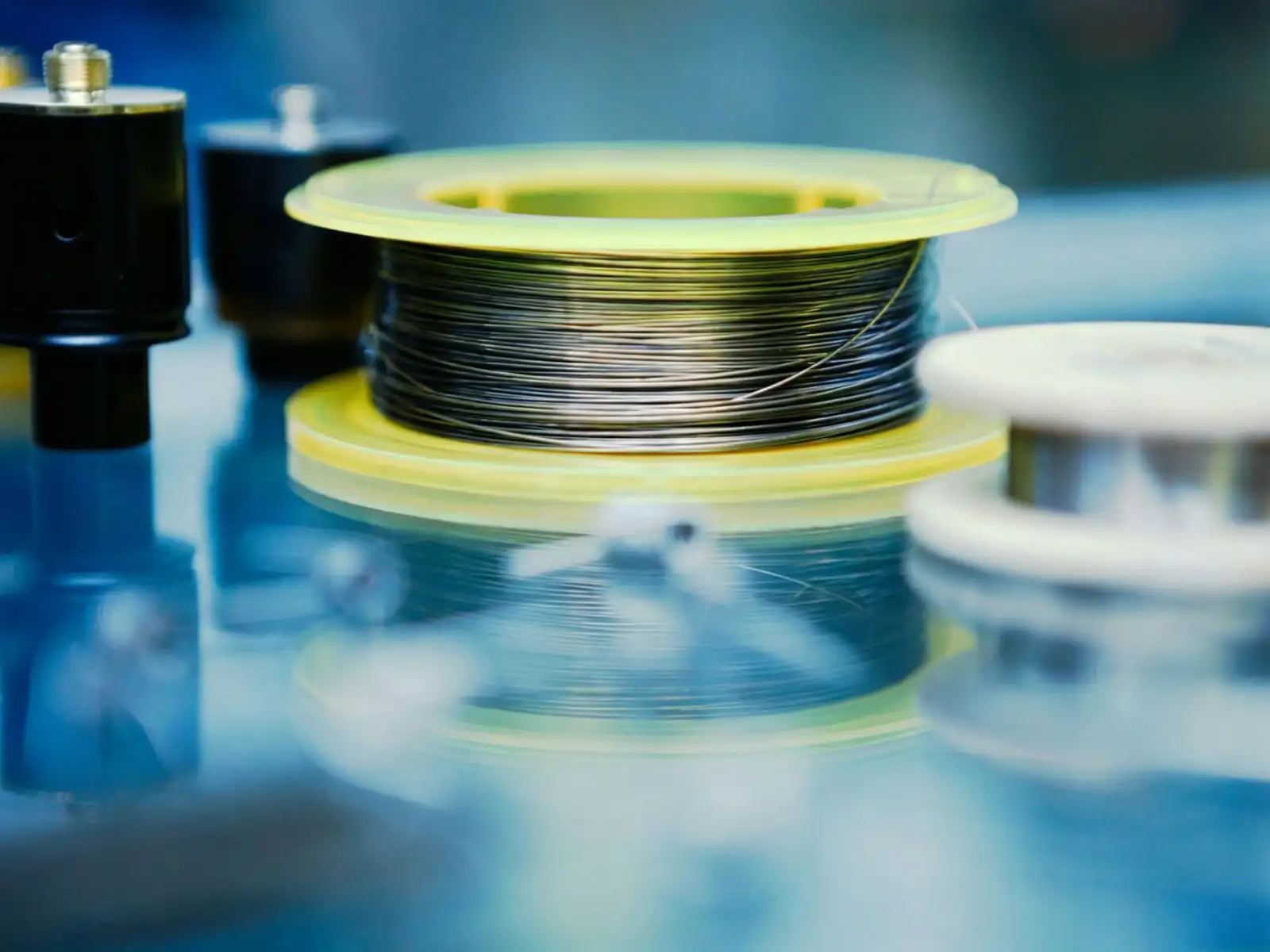
Titanium Grade 1 wire is commercially pure titanium supplied in specified diameters, conditions and surfaces. The order should state whether the wire will be formed, woven, fabricated or used under a welding filler specification.
1. Selection and Acceptance Decisions
- Compare Grade 1 and Grade 2 at the same diameter and condition when formability drives the decision.
- Specify annealed or other required condition explicitly and agree how coil set or straightness is measured.
- For filler applications, request the required filler classification and documentation rather than relying on the base-metal grade alone.
Send a specification for this material with the grade, dimensions, quantity, intended use and the acceptance details listed above. Ask for confirmation of the quoted size, condition and documentation.
2. Chemical Composition
Element (max %) | Grade 1 limit |
Oxygen (O) | 0.18 |
Iron (Fe) | 0.20 |
Carbon (C) | 0.08 |
Nitrogen (N) | 0.03 |
Hydrogen (H) | 0.015 |
Other elements (each / total) | 0.05 / 0.20 |
Titanium (Ti) | Balance (≥ 99.5% as commercial internal control) |
Table 1 — ASTM B863 Grade 1 composition limits (Ti is defined as remainder in the standard).
3. Mechanical and Physical Properties
Property | Value |
Tensile (min, annealed) | ≥ 240 MPa |
Elongation (min, annealed) | 24% |
Density | ≈ 4.51 g/cm³ |
Electrical resistivity | ≈ 0.55 µΩ·m |
Thermal conductivity | ≈ 15–22 W/(m·K) |
Magnetism | Non-magnetic (weakly paramagnetic) |
Service temperature (oxidizing air) | ≈ 300–350℃ practical ceiling |
Table 2 — Annealed properties per ASTM B863 Grade 1 and typical physical data.
4. Conditions: M, Y2 and Y
Grade 1 wire ships in three conditions: annealed (M) — maximum ductility for spring winding, medical braiding and welding; half-hard (Y2) and hard (Y) — commercial temper states for stiffer parts, with mechanicals agreed between buyer and supplier rather than fixed by the standard. Match the condition to the downstream process, not to habit.
Applications
- Medical — guide-wire skeletons, fixation wire, woven electrode meshes, MRI-compatible hardware (ISO 5832-2 / ASTM F67 regime where implanted);
- Welding — ERTi-1 filler (AWS A5.16) for Grade 1 fabrications, φ0.8–3.0 mm;
- Precision electronics — MEMS cantilevers, sensor leads, micro spring contacts with φ0.06–1.0 mm fine-wire tolerance to ±0.01 mm class;
- Chemical — anode baskets, filter screens, spiral heat-exchanger netting.
5. Standards
Grade 1 wire is ordered to ASTM B863 Grade 1; welding filler to AWS A5.16 ERTi-1; medical to ASTM F67 / ISO 5832-2; Chinese supply references GB/T 3623 (TA1). See the titanium wire category.
FAQ
(1) What is the difference between Grade 1 and Grade 2 wire?
Oxygen: 0.18% versus 0.25%. Grade 1 draws to finer diameters with fewer breaks, bends and braids more easily, and is preferred for medical and precision electronics; Grade 2 adds strength (≥ 345 MPa) for general industrial duty.
(2) Can Grade 1 wire be welded with?
Grade 1 wire is itself the ERTi-1 filler for welding Grade 1 structures; as base wire it welds with TIG under full inert-gas shielding.
(3) What is the finest diameter available?
The φ0.06 mm class is commercial fine-wire practice, with tolerances to ±0.01 mm; finer and tighter combinations are reviewed case by case. Custom size, condition, tolerance and documentation can be reviewed to the purchase specification.
(4) Is Grade 1 wire truly non-magnetic?
It is weakly paramagnetic and treated as non-magnetic for engineering purposes — the basis of its MRI-adjacent use — but device-level magnetic compatibility should be verified by magnetometry where it is critical.
(5) Which documents should accompany Grade 1 wire?
A quality certificate with heat number, full chemistry (O/N/H by inert-gas fusion), tensile and elongation for the condition, diameter and ovality data — EN 10204 3.1 class — plus batch traceability.
Related Resources and Inquiry
See the titanium wire category or send your specification for Grade 1 wire supply.
Baoji Titanium Valley Titanium Nickel Zirconium Material Processing Co., Ltd. produces titanium wire and welding wire per ASTM B863 / AWS A5.16 from a dedicated drawing line, from fine wire to welding filler on spools, under ISO 9001 / ISO 13485. Send your specification to sales@titaniumvalleys.com — Custom size, condition, tolerance and documentation can be reviewed to the purchase specification.
6. Related Reading
- Titanium Wire Drawing: Process Stages and Defect Control
- Titanium Weld Wire: Filler Selection and Procedure Review
References
1. ASTM B863, Standard Specification for Titanium and Titanium Alloy Wire.
2. AWS A5.16/A5.16M, Specification for Titanium and Titanium Alloy Welding Electrodes and Rods.
3. ASTM F67, Standard Specification for Unalloyed Titanium, for Surgical Implant Applications.
4. ISO 5832-2, Implants for Surgery — Metallic Materials — Unalloyed Titanium.
5. ASTM E8/E8M, Standard Test Methods for Tension Testing of Metallic Materials.
6. GB/T 3623, Titanium and Titanium Alloy Wire.
This article is a technical reference. It does not constitute a commercial offer; dimensions, tolerances and documentation are confirmed at order review.
Published by: Titanium Valley Technical Team. Technical and quality review: pending.