
Titanium Wire Drawing: Process Stages and Defect Control
- Titanium Wire Drawing
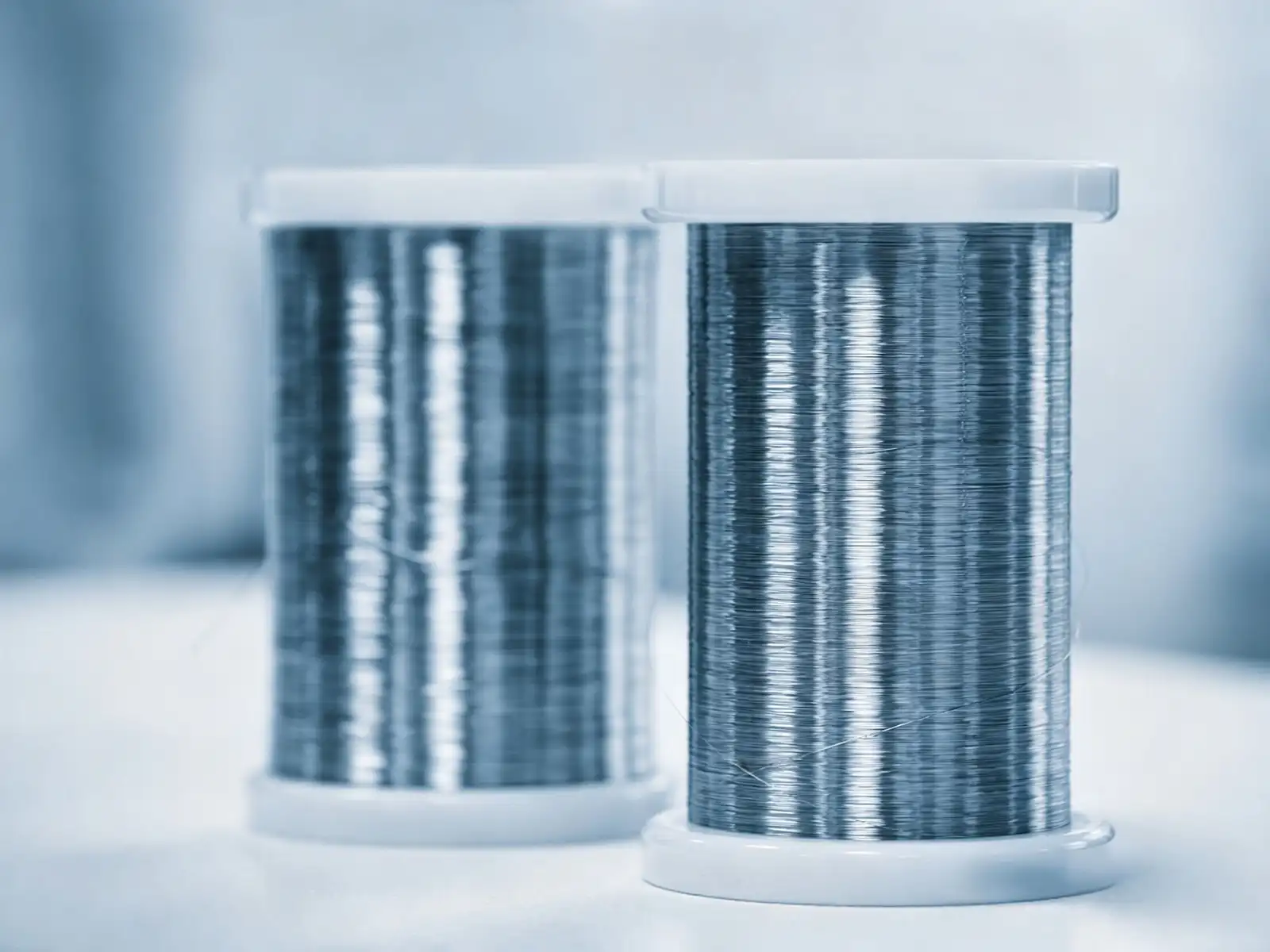
Titanium wire drawing reduces wire through successive processing stages that must control dimensions, surface and delivery condition. Review the drawing route together with inspection and handling before setting final-wire acceptance.
1. Selection and Acceptance Decisions
- At incoming material, establish grade, identity and the condition entering the drawing route.
- At drawing and intermediate processing, record the controls relevant to diameter variation, surface marks and cleanliness.
- At release, agree diameter measurement, coil or straightness acceptance and lot traceability. Identify which stages belong to the wire supplier and which belong upstream.
Send a specification for this material with the grade, dimensions, quantity, intended use and the acceptance details listed above. Ask for confirmation of the quoted size, condition and documentation.
2. Stage 1: Sponge to Ingot
High-grade sponge titanium is compacted into electrodes and melted in a vacuum arc remelting (VAR) furnace, typically two to three melts, to remove volatile impurities and homogenize chemistry. Every heat gets full analysis — metal elements by spectrometry, O/N/H by inert-gas fusion — and the heat number follows the material to the finished spool.
3. Stage 2: Hot Rolling to Wire Rod
Ingots are forged into billets, heated to about 850–950℃ and rolled on continuous horizontal/vertical mills into wire rod of φ5.5–8.0 mm. Temperature control is the quality lever: too hot coarsens the β grains and thickens the oxide, too cold raises rolling resistance. The rod is descaled, peeled or pickled and coiled for drawing.
4. Stage 3: Multi-Pass Cold Drawing
Cold drawing reduces the rod to final size through successive dies — tungsten-carbide for coarse and medium passes, diamond or PCD dies for fine wire — with each pass taking a controlled area reduction. Titanium work-hardens quickly, so intermediate annealing (vacuum or inert atmosphere, roughly 600–750℃) is scheduled every few passes to restore ductility and prevent breakage. Roller-die drawing is used for part of the route where surface finish and residual-stress distribution matter. Lubrication is titanium-specific: no chlorinated products.
5. Stage 4: Final Annealing and the α-Case Discipline
Final annealing sets the delivery condition — annealed for ductility, or interrupted earlier for cold-worked temper. Because titanium absorbs oxygen and nitrogen at temperature, annealing runs under vacuum or argon to prevent the brittle alpha-case surface layer; furnace temperature tolerance and soak time determine batch-to-batch consistency.
6. Stage 5: Finishing and Inspection
The wire is pickled (silver-gray) or bright-finished, straightened to ≤2 mm/m class, cut to length or spooled, and inspected: laser diameter gauging in line, eddy-current testing for surface and near-surface flaws, plus batch tensile tests and chemistry checks against ASTM B863. The certificate that ships with the spool is the audit trail of every stage above.
FAQ
(1) Why does titanium wire need intermediate annealing?
Titanium work-hardens rapidly; without periodic recrystallization the wire becomes brittle and breaks in the die. Intermediate vacuum/inert annealing restores ductility between passes.
(2) Why are diamond dies used for fine wire?
Diamond and PCD dies hold their geometry and surface finish far longer than carbide at sub-millimeter diameters, which is what keeps fine wire round and defect-free.
(3) What is alpha-case and why does it matter?
Alpha-case is the oxygen-enriched, brittle surface layer that forms if titanium is heated in air. Vacuum or inert annealing prevents it; its absence is visible in consistent surface quality and ductility.
(4) How is diameter controlled during drawing?
By die geometry and pass scheduling, verified with in-line laser gauging; commercial tolerance practice is ±0.05 mm class, with ±0.01 mm available for fine wire.
(5) Which standards govern drawn titanium wire?
ASTM B863 for wire product, AWS A5.16 for welding filler, and GB/T 3623 in the Chinese system; medical wire adds ASTM F67/F136. Custom size, condition, tolerance and documentation can be reviewed to the purchase specification.
Related Resources and Inquiry
See the titanium wire category or send your specification to discuss a drawing program.
Baoji Titanium Valley Titanium Nickel Zirconium Material Processing Co., Ltd. produces titanium wire and welding wire per ASTM B863 / AWS A5.16 from a dedicated drawing line, from fine wire to welding filler on spools, under ISO 9001 / ISO 13485. Send your specification to sales@titaniumvalleys.com — Custom size, condition, tolerance and documentation can be reviewed to the purchase specification.
7. Related Reading
- Titanium Grade 1 Wire: Diameter, Condition and End Use
- Titanium Welding Wire Factory: Production and Inspection Audit
References
1. ASTM B863, Standard Specification for Titanium and Titanium Alloy Wire.
2. AWS A5.16/A5.16M, Specification for Titanium and Titanium Alloy Welding Electrodes and Rods.
3. ASTM E8/E8M, Standard Test Methods for Tension Testing of Metallic Materials.
4. GB/T 3623, Titanium and Titanium Alloy Wire.
This article is a technical reference. It does not constitute a commercial offer; dimensions, tolerances and documentation are confirmed at order review.
Published by: Titanium Valley Technical Team. Technical and quality review: pending.