
Grade 4 Titanium Foil: Strength, Bendability and Selection
- Grade 4 Titanium Foil
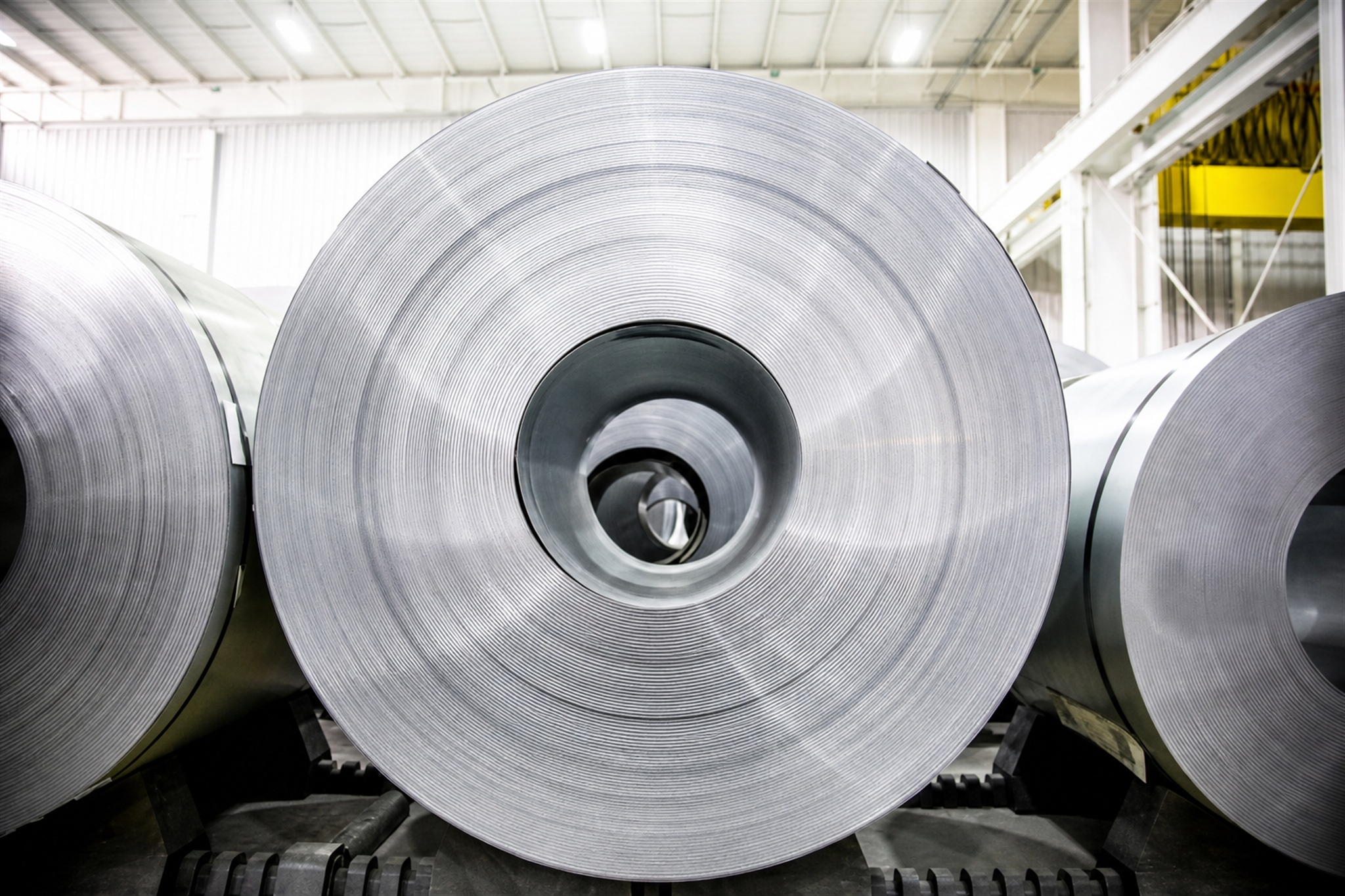
Choose Grade 4 titanium foil when a commercially pure grade needs higher strength and the part can accommodate the forming limits. Before switching from Grade 2, check bend radius, rolling direction and springback on a sample at the ordered gauge. View related foil specifications.
Grade 4 vs Grade 2 for a formed part
Trial the actual gauge in both rolling directions. Record the smallest acceptable radius, springback after unloading and edge condition after forming. Use those results to confirm whether the extra strength is useful in the finished part.
Composition: The Top of the Oxygen Ladder
Element (max %) | Grade 1 | Grade 2 | Grade 4 |
Oxygen (O) | 0.18 | 0.25 | 0.40 |
Iron (Fe) | 0.20 | 0.30 | 0.50 |
Nitrogen (N) | 0.03 | 0.03 | 0.05 |
Carbon (C) | 0.08 | 0.08 | 0.08 |
Hydrogen (H) | 0.015 | 0.015 | 0.015 |
Table 1 — The CP strength ladder is an oxygen ladder: each step up raises strength and lowers ductility (ASTM B265 limits).
Mechanical and Physical Properties
Property | Value |
Tensile strength (min) | ≥ 550 MPa (80 ksi) |
Yield strength | 483–655 MPa |
Elongation (min) | 15% |
Density | ≈ 4.51 g/cm³ |
Melting point | ≈ 1668℃ |
Magnetism | Non-magnetic |
Table 2 — Annealed properties per ASTM B265 and typical physical data.
Processing Discipline
Recrystallization annealing for Grade 4 foil is typically run at 550–650℃; temperatures above 700℃ are avoided to prevent grain coarsening and property scatter. Compared with Grade 2, forming needs more pressure and better lubrication, and springback is higher — budget for slightly larger process development. A second delivery option matters for Grade 4: cold-hard (temper) strip at 0.2–0.4 mm raises strength further for spring and clip applications where the annealed condition is too soft. Welding remains straightforward under inert-gas shielding, and aerospace orders commonly cite AMS 4901.
Applications by Thickness Band
Application | Typical thickness | Process | Key requirement |
Strain-gauge and sensor substrates | 0.02–0.05 mm | Precision rolling of high-purity foil | Fatigue resistance, elastic response, environmental stability |
EMI shielding foil | 0.05–0.1 mm | Slitting / etching / stamping | Non-magnetic, low density, corrosion resistance |
Precision etched parts / lead frames | 0.05–0.15 mm | Double-sided etching + post-processing | Burr-free edges, high aspect ratio, batch consistency |
Table 3 — Foil band (0.02–0.2 mm): high-strength precision parts.
Application | Typical thickness | Process | Key requirement |
Precision springs and clips | 0.2–0.4 mm | Cold-hard (temper) strip + forming | Elastic fatigue life, non-magnetic |
Medical device housings and parts | 0.2–0.5 mm | Stamping / deep drawing | Biocompatible, non-magnetic, sterilization-resistant |
Electroplating anode baskets | 0.3–0.5 mm | Welded forming | Acid-bath stability, stable material retention |
Table 4 — Strip band (0.2–0.5 mm): springs, clips and medical housings.
Application | Typical thickness | Process | Key requirement |
Bone plates / internal fixation | 0.6–1.0 mm | Stamping + machining + surface treatment | Elastic modulus near bone, non-magnetic, biocompatible |
Dental implants and abutments | 0.5–1.0 mm | Turning + threading + sandblasting/acid-etching | Osseointegration, saliva corrosion resistance, non-toxic |
Chemical corrosion-resistant components | 0.5–1.0 mm | Forming / welding | Resistance to acids and chloride media |
Marine / seawater heat exchange and structure | 0.5–1.0 mm | Forming / welding | Seawater corrosion resistance, anti-fouling |
Sports equipment | 0.5–1.0 mm | Forming / machining | Light, strong, weatherproof, good feel |
Titanium crafts and souvenirs | 0.5–1.0 mm | Anodized coloring | Gradient iridescent colors, metallic finish |
Table 5 — Sheet band (0.5–1.0 mm): medical, chemical and marine Grade 4 parts.
1. Deep Dive: Precision springs and clips
Precision springs and clips rolled to cold-hard temper at 0.2–0.4 mm exploit Grade 4’s position as the strongest CP grade: roughly 40% lighter than steel springs, non-magnetic and corrosion-free — the profile that aerospace clamps, medical instruments and precision mechanisms specify where steel springs would rust, weigh or interfere.
2. Deep Dive: Bone plates / internal fixation
Bone plates and internal fixation hardware stamped and machined from 0.6–1.0 mm sheet use CP titanium (Grade 4 or Grade 2) for a modulus closer to bone than stainless steel or cobalt alloys, which reduces stress shielding at the fracture site. Non-magnetic behavior keeps patients eligible for post-operative MRI, and the material can remain implanted long-term. Implant supply is ordered to ASTM F67.
3. Deep Dive: Dental implants and abutments
Dental implants and abutments are turned and threaded from 0.5–1.0 mm CP sheet stock, then sandblasted and acid-etched to promote osseointegration. CP titanium’s bone-bonding behavior, saliva corrosion resistance and non-toxicity make it — alongside Ti-6Al-4V — the mainstream dental implant material.
4. Deep Dive: Chemical corrosion-resistant components
Reactor linings, trays and vessel partitions in 0.5–1.0 mm Grade 4 sheet extend chemical equipment life across aggressive acid and chloride duties; ship condensers, desalination plates and hull structures use the same grade where seawater corrosion rules out everything else.
Standards
Grade 4 foil is ordered to ASTM B265 (UNS R50700), with AMS 4901 for aerospace strip practice and ASTM F67 (ISO 5832-2) for surgical material. Chinese designation: TA4. See the Grade 4 titanium foil product page.
FAQ
(1) What is the difference between Grade 4 and Grade 2 titanium foil?
Grade 4 is about 60% stronger (≥ 550 MPa vs ≥ 345 MPa tensile, yield 483–655 vs 275–450 MPa) at the cost of ductility (≥ 15% vs ≥ 20%). Choose Grade 2 for general corrosion service, Grade 4 where thin parts carry load.
(2) Can Grade 4 titanium foil be deep drawn?
Yes, but its process window is narrower than Grade 1 or Grade 2: more blank-holder control, better lubrication and annealed delivery are needed. For complex deep-drawn shapes, Grade 1 remains the safer choice.
(3) Is Grade 4 foil still weldable?
Yes. It welds well with TIG or laser under proper shielding. The higher oxygen content slightly reduces weld ductility relative to Grade 2 — worth remembering for highly stressed weldments.
(4) What annealing temperature is used for Grade 4 foil?
Recrystallization annealing is typically 550–650℃; temperatures above 700℃ are avoided to prevent grain coarsening and property scatter.
(5) Can Grade 4 be supplied cold-worked for springs?
Yes — cold-hard temper strip at 0.2–0.4 mm is the standard route for precision springs and clips, trading formability for higher strength and better elastic performance.
(6) Which documents are needed for aerospace-grade Grade 4 foil?
An MTR with full chemistry, tensile and elongation for the correct thickness band, delivery condition and AMS 4901/B265 edition, plus batch traceability documents; many programs add ultrasonic or dimensional inspection records. Custom size, condition, tolerance and documentation can be reviewed to the purchase specification.
(7) How should Grade 4 foil be stored?
Dry storage at 15–25℃ and ≤ 60% relative humidity, with edge protection and clean handling gloves — thin titanium edges are sharp, and moisture-trapping interleaving invites surface staining over long storage.
Related Resources and Inquiry
See the titanium foil category for the full grade ladder or send your specification for a Grade 4 order review.
Baoji Titanium Valley Titanium Nickel Zirconium Material Processing Co., Ltd. operates a 750 mm 20-high titanium foil line (3, 000 t/yr, ISO 9001 / ISO 13485) covering the full 0.02–1.0 mm range with etching, stamping and welding compatibility. Send your specification to sales@titaniumvalleys.com — Custom size, condition, tolerance and documentation can be reviewed to the purchase specification.
References
1. ASTM B265, Standard Specification for Titanium and Titanium Alloy Strip, Sheet, and Plate.
2. ASTM F67, Standard Specification for Unalloyed Titanium, for Surgical Implant Applications.
3. ASTM E8/E8M, Standard Test Methods for Tension Testing of Metallic Materials.
4. SAE AMS 4901, Titanium Sheet, Strip, and Plate, Commercially Pure, Annealed, 70.0 ksi (483 MPa) Yield Strength.
5. Baoji Titanium Valley: 0.02–1.0 mm Titanium and Titanium Alloy Strip and Foil — Application Introduction (internal application deck).
6. Titanium Valley product data: Gr4 Titanium Foil product page (titaniumvalleys.com).
This article is a technical reference. It does not constitute a commercial offer; dimensions, tolerances and documentation are confirmed at order review.
Published by: Titanium Valley Technical Team. Technical and quality review: pending.