
Grade 5 Titanium Rod: Machining Stock and Delivery Condition
- Grade 5 Titanium Rod
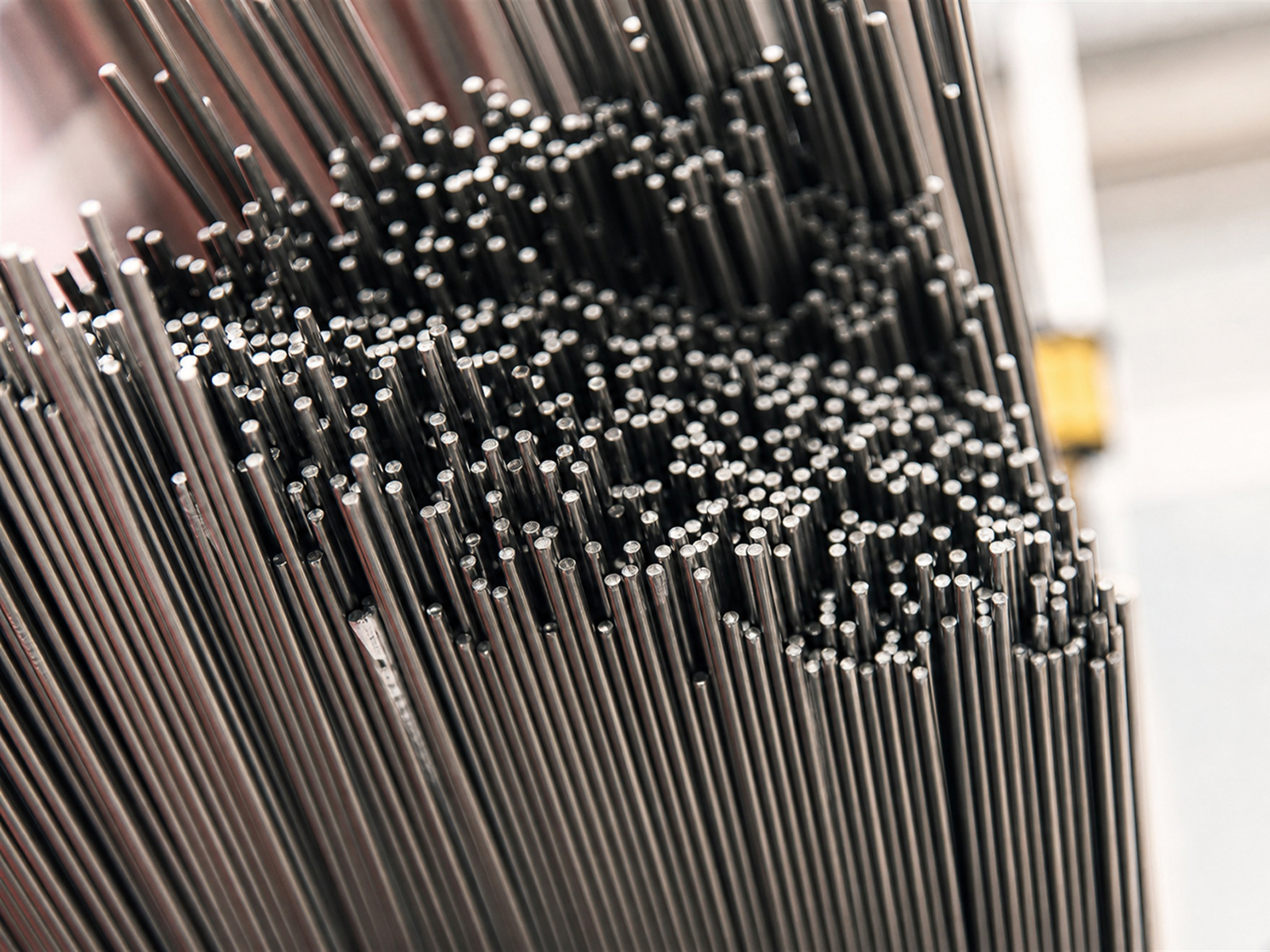
Grade 5 titanium rod is Ti-6Al-4V stock for components that require an alloy grade. For machining orders, the useful specification joins grade and delivery condition to diameter, straightness, surface and material removal allowance.
1. Selection and Acceptance Decisions
- Separate stock diameter from the final component dimensions and identify the required cleanup allowance.
- Describe whether the first operation is turning, drilling, threading or another process so the stock format can be reviewed.
- Use mechanical values for the governing standard, size and condition, and request heat identification on the shipment.
Send a specification for this material with the grade, dimensions, quantity, intended use and the acceptance details listed above. Ask for confirmation of the quoted size, condition and documentation.
2. Chemical Composition
Element | Content (%) |
Aluminum (Al) | 5.50–6.75 |
Vanadium (V) | 3.50–4.50 |
Iron (Fe) | ≤ 0.40 |
Oxygen (O) | ≤ 0.20 |
Carbon (C) | ≤ 0.08 |
Nitrogen (N) | ≤ 0.05 |
Hydrogen (H) | ≤ 0.015 |
Titanium (Ti) | Balance |
Table 1 — ASTM B348 Grade 5 composition limits. Residual elements: 0.10% each, 0.30% total.
3. Mechanical and Physical Properties
Property | Value |
Tensile strength (min) | ≥ 895 MPa (130 ksi) |
Yield strength (min) | ≥ 828 MPa |
Elongation (min) | 10% |
Hardness (typical) | ≈ 280–340 HB |
Density | 4.43 g/cm³ |
Elastic modulus | ≈ 110–114 GPa |
Thermal conductivity | ≈ 6.7–7.2 W/(m·K) |
Service temperature | 350–400℃ continuous class; 500℃ short excursions |
Table 2 — Annealed properties per ASTM B348 Grade 5 and typical physical data.
4. Machining: The Hard Part
Ti-6Al-4V is a textbook difficult-to-machine material. Thermal conductivity is about 1/7 of steel, so cutting heat concentrates at the tool edge; the low modulus (≈ 110 GPa) lets the workpiece spring away from the tool; and titanium’s chemical affinity causes built-up edge. Shop practice: carbide tooling (uncoated WC-Co or AlCrN-class coatings — TiAlN is avoided because titanium-to-titanium affinity worsens pickup), cutting speeds around 30–60 m/min, small feeds, and generous high-pressure coolant. Budget more tool cost and cycle time than for steel, and machine annealed stock for dimensional stability.
Conditions and Surfaces
- Annealed — low residual stress, best machinability and weldability; the default for machining;
- Hot-worked / hot-finished — higher strength, more internal stress; expect distortion in fine cuts;
- Surfaces — black (as-forged/rolled), peeled (silver, tighter tolerance), turned bright bar, ground (Ra < 0.8 µm for precision shafts).
Applications
- Aerospace — fasteners, brackets, fittings and landing-gear hardware to AMS 4928;
- Motorsport and automotive — suspension springs ~40–50% lighter than steel, connecting hardware, exhaust-system brackets rated for 350–400℃ service;
- Marine and offshore — pump shafts, valve stems and seawater fasteners;
- Medical — instrument stock; implants move to Ti-6Al-4V ELI per ASTM F136 / ISO 5832-3;
- Oil and gas — downhole and topside components in chloride service (with galvanic isolation in mixed-metal assemblies).
5. Standards
Grade 5 rod is ordered to ASTM B348 Grade 5 (UNS R56400), AMS 4928 for aerospace practice, and ASTM F136 (Grade 23 ELI) where implant-grade chemistry is required. Chinese designation: TC4 (GB/T 2965). See the Grade 5 titanium rod product page and the ASTM B348 aerospace Gr5 ELI bar page.
FAQ
(1) What is the maximum service temperature of Grade 5 rod?
About 350–400℃ for continuous structural service, with short excursions near 500℃. Above 500℃ oxidation and creep erode properties — move to a high-temperature titanium alloy or superalloy.
(2) Why is Grade 5 rod difficult to machine?
Low thermal conductivity traps heat in the tool, low modulus causes springback, and chemical affinity builds up edge. Carbide tools, 30–60 m/min speeds and high-pressure coolant are the standard remedies.
(3) Can Grade 5 rod be welded?
Yes — TIG or electron-beam under full inert-gas shielding, with pre-weld degreasing and post-weld stress relief for highly stressed joints. Fracture-critical welds often prefer the ELI variant (Grade 23).
(4) Is ordinary Grade 5 rod suitable for implants?
No — implants require Ti-6Al-4V ELI (Grade 23) with tighter oxygen and iron limits, ordered to ASTM F136 / ISO 5832-3. Ordinary Grade 5 does not automatically satisfy implant chemistry.
(5) Which condition should I order for machining?
Annealed: lowest residual stress and best dimensional stability. Hot-worked stock distorts more in fine cuts.
(6) How much lighter is a Grade 5 part than steel?
About 43–44% at equal volume. At equal strength the saving depends on the steel and the design — typically 30–40% for parts sized to strength.
(7) Does Grade 5 rod anodize?
Specify the required anodic treatment and acceptance criteria with the processor. Approve a representative sample for appearance and qualify any bonding or functional surface requirements for the intended assembly.
(8) What documentation should a Grade 5 rod shipment carry?
An MTR with full chemistry (Al, V, Fe, O, N, C, H), tensile and elongation, condition and standard edition; add NDT records and AMS 4928 conformance where the application requires. Custom size, condition, tolerance and documentation can be reviewed to the purchase specification.
6. Related Resources and Inquiry
See the titanium rod category for the full grade ladder, or send your specification for a Grade 5 rod quote.
Baoji Titanium Valley Titanium Nickel Zirconium Material Processing Co., Ltd. produces titanium rod and barstock from VAR-melted ingots on a rolling line rated over 20, 000 t/yr, per ASTM B348 / GB/T 2965, with cold-drawn, hot-rolled and forged routes. Send your specification to sales@titaniumvalleys.com — Custom size, condition, tolerance and documentation can be reviewed to the purchase specification.
7. Related Reading
References
1. ASTM B348/B348M, Standard Specification for Titanium and Titanium Alloy Bars and Billets.
2. ASTM E8/E8M, Standard Test Methods for Tension Testing of Metallic Materials.
3. SAE AMS 4928, Titanium Alloy Bars, Wire, Forgings and Rings, 6Al-4V, Annealed.
4. ASTM F136, Standard Specification for Wrought Titanium-6Aluminum-4Vanadium ELI Alloy for Surgical Implant Applications.
5. GB/T 2965, Titanium and Titanium Alloy Bars.
This article is a technical reference. It does not constitute a commercial offer; dimensions, tolerances and documentation are confirmed at order review.
Published by: Titanium Valley Technical Team. Technical and quality review: pending.