
Grade 12 Titanium Rod: When to Review It Against Grade 2
- Grade 12 Titanium Rod
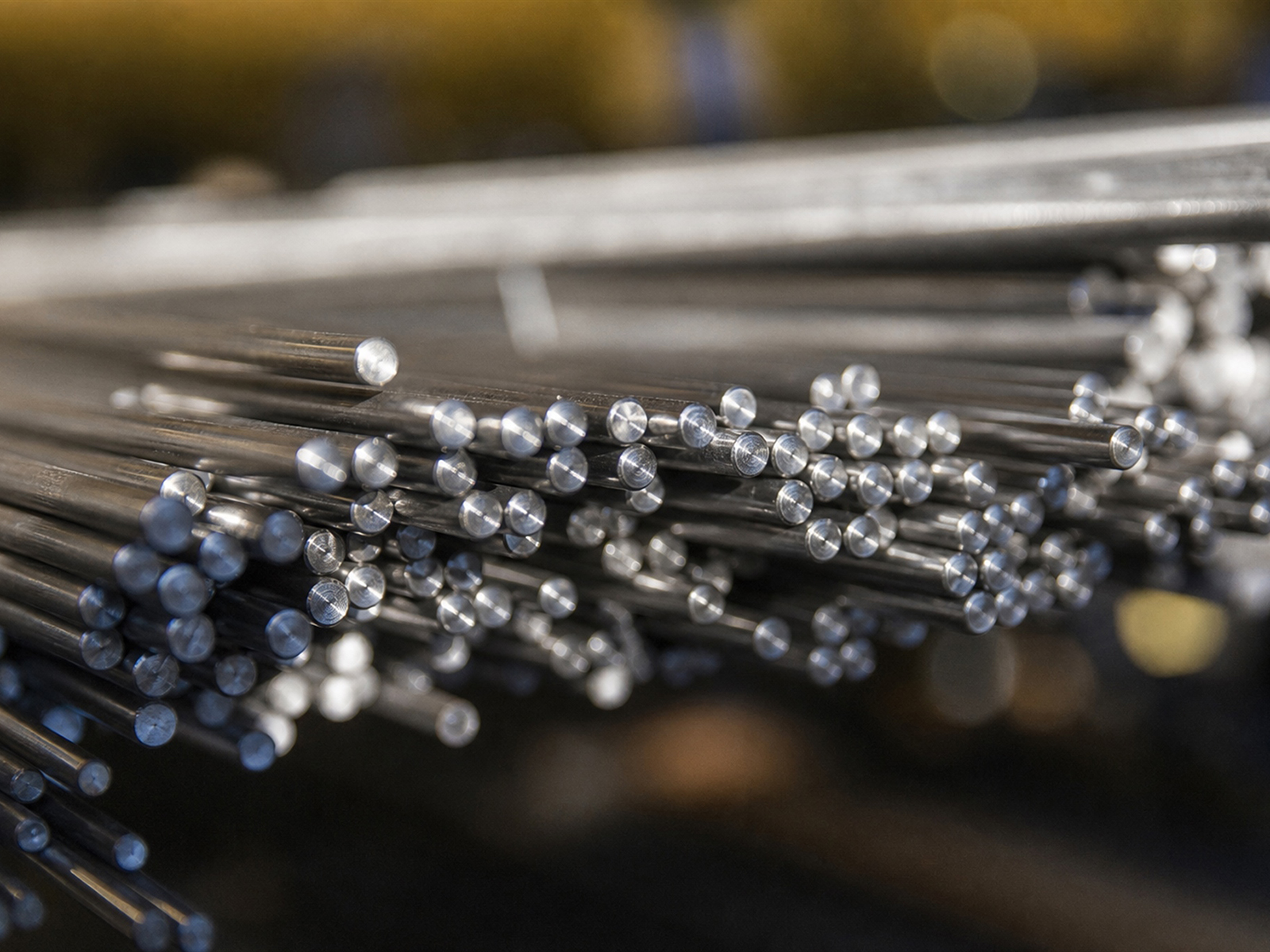
Grade 12 titanium rod is a candidate for corrosion-service components when commercially pure titanium needs a closer service review. Compare it with Grade 2 using the actual fluid, temperature, fabrication and mechanical requirements.
1. Selection and Acceptance Decisions
- Provide medium, concentration, temperature, contaminants and crevice conditions for a service review.
- Compare rod grade and section size together rather than choosing from strength figures alone.
- State the fabrication and inspection route, including welding and any special service qualification required by the design.
Send a specification for this material with the grade, dimensions, quantity, intended use and the acceptance details listed above. Ask for confirmation of the quoted size, condition and documentation.
2. Chemical Composition
Element | Content (%) | Role |
Molybdenum (Mo) | 0.20–0.40 | Improves uniform-corrosion resistance in dilute reducing acids |
Nickel (Ni) | 0.60–0.90 | Improves crevice-corrosion resistance in chloride service |
Oxygen (O) | ≤ 0.25 | Strength control |
Iron (Fe) | ≤ 0.30 | Impurity |
Nitrogen (N) / Carbon (C) / Hydrogen (H) | ≤ 0.03 / ≤ 0.08 / ≤ 0.015 | Impurity limits |
Titanium (Ti) | Balance | — |
Table 1 — Grade 12 composition per ASTM B348 (confirm limits against the contracted edition).
3. Mechanical Properties
Property | Grade 12 | Grade 2 (reference) |
Tensile strength (min) | ≥ 483 MPa (70 ksi) | ≥ 345 MPa |
Yield strength (min) | ≥ 345 MPa | ≥ 275 MPa |
Elongation (min) | 18% | 20% |
Reduction of area (min) | 25% | 30% |
Density | ≈ 4.51 g/cm³ | 4.51 g/cm³ |
Table 2 — Annealed minimums per ASTM B348: stronger than Grade 2, ductility slightly below it, still far above Grade 5.
4. Where Grade 12 Beats Pure Titanium
Two environments define Grade 12. Crevices: in seawater, brine and chloride process streams, pure titanium can lose its film inside tight crevices (gasket faces, tube-sheet roots) where the local pH drops; the Ni addition stabilizes the film there, raising the critical crevice-corrosion temperature. Reducing acids: dilute HCl and H₂SO₄ attack pure titanium, while the Mo-Ni combination widens the usable concentration/temperature window — still narrow, so verify against the actual medium rather than assuming immunity. For sour service, Grade 12 sits comfortably in the NACE MR0175/ISO 15156 framework for H₂S-containing environments.
Applications
- Heat exchangers and desalination — tube plates, spacers and support rods in hot seawater duty;
- FGD and chemical equipment — absorber internals, spray-pipe supports, agitator parts;
- Oil and gas — topside and downhole components in produced-water and H₂S/CO₂ service;
- Welded fabrications — ERTi-12 filler matches the rod for TIG work under inert-gas shielding.
5. Standards and Ordering
Grade 12 rod is ordered to ASTM B348 Grade 12 (UNS R53400; GB/T 2965 designation TA10). NDT is not a default B348 item — write ultrasonic or eddy-current inspection into the order for load-bearing parts. Not an implant grade: Grade 12 contains nickel and is not covered by ISO 5832, so medical applications require separate material equivalence and biocompatibility evaluation. Custom size, condition, tolerance and documentation can be reviewed to the purchase specification.
FAQ
(1) What is the difference between Grade 2 and Grade 12 rod?
Grade 12 adds 0.2–0.4% Mo and 0.6–0.9% Ni: about 40% higher tensile minimum (483 vs 345 MPa), slightly lower ductility, and clearly better crevice-corrosion and reducing-acid resistance.
(2) Is Grade 12 rod suitable for seawater heat exchangers?
Yes — it is a standard choice where hot seawater and tight crevices rule out pure titanium, and it welds readily with ERTi-12 filler under inert-gas shielding.
(3) Can Grade 12 be used in sour service?
It is used within the NACE MR0175/ISO 15156 material framework for H₂S-containing environments; confirm the specific component and environment against the standard’s tables.
(4) Is Grade 12 an implant grade?
No — it contains nickel and has no ISO 5832 counterpart. Implant applications require separate biocompatibility evaluation; choose Grade 4 or Ti-6Al-4V ELI for regulated implant duty.
(5) What elongation should I expect?
≥ 18% annealed — below Grade 2 (≥ 20%) but well above Grade 5 (≥ 10%), so cold forming remains practical with slightly larger bend radii.
Related Resources and Inquiry
See the titanium rod category or send your specification for a Grade 12 rod review.
Baoji Titanium Valley Titanium Nickel Zirconium Material Processing Co., Ltd. produces titanium rod and barstock from VAR-melted ingots on a rolling line rated over 20, 000 t/yr, per ASTM B348 / GB/T 2965, with cold-drawn, hot-rolled and forged routes. Send your specification to sales@titaniumvalleys.com — Custom size, condition, tolerance and documentation can be reviewed to the purchase specification.
6. Related Reading
- Grade 2 Titanium Rod: Corrosion Service and Fabrication
- Titanium Alloy Rod: A Grade Selection Workflow
References
1. ASTM B348/B348M, Standard Specification for Titanium and Titanium Alloy Bars and Billets.
2. ASTM E8/E8M, Standard Test Methods for Tension Testing of Metallic Materials.
3. NACE MR0175/ISO 15156, Petroleum and Natural Gas Industries — Materials for Use in H₂S-Containing Environments.
4. GB/T 2965, Titanium and Titanium Alloy Bars.
This article is a technical reference. It does not constitute a commercial offer; dimensions, tolerances and documentation are confirmed at order review.
Published by: Titanium Valley Technical Team. Technical and quality review: pending.