
Titanium Steel Rods: Comparing Titanium and Steel Stock
- Titanium vs Steel Rods
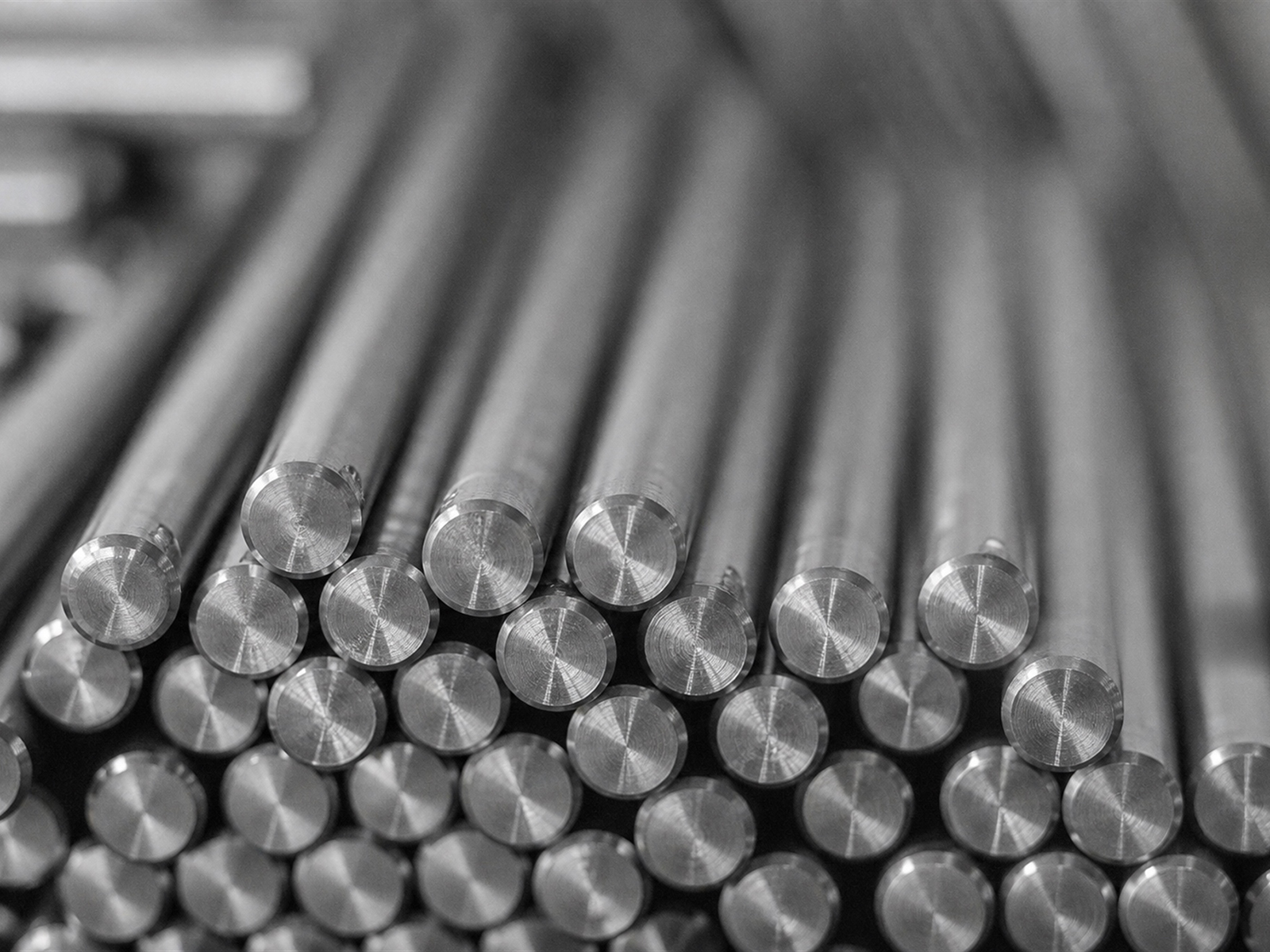
Titanium steel rods is an ambiguous search term. For a material decision, identify whether titanium or steel is required, then compare actual grades and component geometry for weight, strength, corrosion and fabrication.
1. Selection and Acceptance Decisions
- Compare equal-volume stock only when explaining density, and compare finished designs when evaluating component mass.
- Use actual grade and condition data for strength and stiffness rather than a general titanium-versus-steel claim.
- Include machining, corrosion protection, joining and service life in the cost comparison, with contact between dissimilar metals reviewed for the environment.
Send a specification for this material with the grade, dimensions, quantity, intended use and the acceptance details listed above. Ask for confirmation of the quoted size, condition and documentation.
2. The Numbers Side by Side
Property | Gr2 titanium rod | Gr5 titanium rod | Alloy steel rod (4340 QT) | 304/316 stainless |
Density | 4.51 g/cm³ | 4.43 g/cm³ | ≈ 7.85 g/cm³ | ≈ 7.9 g/cm³ |
Tensile (typ.) | 345–480 MPa | 895–1, 000 MPa | ≈ 1, 000–1, 800 MPa | 515–620 MPa |
Weight vs steel (equal volume) | −43% | −44% | — | ≈ 0% |
Chloride / seawater | Immune in most service | Excellent | Rusts | Pits above moderate Cl⁻/temp |
Magnetic | Non-magnetic | Non-magnetic | Magnetic | Weakly/non-magnetic |
Table 1 — Typical annealed/heat-treated property ranges for comparison. Steel strength depends strongly on heat treatment; titanium values are standard minimums.
3. Strength and Weight: Read the Fine Print
Two different questions produce two different answers. Equal volume: titanium saves ~43–44% weight at similar or lower strength, depending on grade. Equal strength: Grade 2 needs a larger section to match alloy steel, shrinking the weight advantage to roughly 15% at equal load capacity; Grade 5 holds its own against many heat-treated steels at ~40% less weight. Design to load, not to diameter.
4. Corrosion: Where Titanium Wins Decisively
In seawater, brine, wet chlorine and oxidizing acids, titanium’s self-healing TiO₂ film outperforms stainless steel and carbon steel without coatings or cathodic protection — the reason marine fasteners, desalination shafts and chemical equipment use titanium rod despite the price. In strongly reducing acids (hot concentrated HCl/H₂SO₄) titanium’s film fails, and steel or other alloys may be the honest choice.
5. Machining and Fabrication
Titanium is the harder material to machine: low thermal conductivity concentrates heat in the tool, so expect carbide tooling, cutting speeds around 30–60 m/min and generous coolant. Welding needs inert-gas discipline. Steel machines faster and welds with conventional processes — a real cost input for large machined components.
6. Cost and the Galvanic Rule
Titanium rod costs several times more than alloy steel per kilogram. Two engineering rules keep the comparison honest: run total-life cost (replacement, downtime, coating maintenance) for corrosive service, and never forget galvanic coupling — titanium in contact with steel or aluminum accelerates corrosion of the less noble metal, so insulate or isolate mixed-metal joints.
FAQ
(1) Is titanium stronger than steel?
By weight, yes for the alloy grades: Grade 5 delivers steel-class strength at ~44% less weight. By section, premium heat-treated steels can exceed Grade 5 in tensile strength. Compare specific strength (strength ÷ density), not just tensile numbers.
(2) When should I replace a steel rod with titanium?
When corrosion, weight or magnetism drives the failure or the maintenance bill: seawater and chemical service, rotating parts where mass matters, MRI-adjacent hardware, and long-life aerospace or medical components.
(3) Does titanium rust?
No — titanium forms a stable, self-healing oxide film. It does not rust like steel; its limits are reducing acids, fluoride environments and high-temperature oxidation.
(4) Why is titanium rod more expensive?
Energy-intensive vacuum melting (VAR), slower machining and higher raw-material cost. The premium typically pays back only in weight-sensitive or corrosion-dominated applications.
(5) Can titanium and steel be used together?
Yes, with galvanic discipline: titanium is cathodic to steel and aluminum, so the steel side needs coating, insulation or cathodic protection to avoid accelerated attack.
7. Related Resources and Inquiry
Compare grades in the titanium rod category or send your specification for a titanium-vs-steel cost review.
Baoji Titanium Valley Titanium Nickel Zirconium Material Processing Co., Ltd. produces titanium rod and barstock from VAR-melted ingots on a rolling line rated over 20, 000 t/yr, per ASTM B348 / GB/T 2965, with cold-drawn, hot-rolled and forged routes. Send your specification to sales@titaniumvalleys.com — Custom size, condition, tolerance and documentation can be reviewed to the purchase specification.
8. Related Reading
- Grade 5 Titanium Rod: Machining Stock and Delivery Condition
- Grade 2 Titanium Rod: Corrosion Service and Fabrication
References
1. ASTM B348/B348M, Standard Specification for Titanium and Titanium Alloy Bars and Billets.
2. ASTM E8/E8M, Standard Test Methods for Tension Testing of Metallic Materials.
3. GB/T 2965, Titanium and Titanium Alloy Bars.
This article is a technical reference. It does not constitute a commercial offer; dimensions, tolerances and documentation are confirmed at order review.
Published by: Titanium Valley Technical Team. Technical and quality review: pending.