
Titanium Barstock: Forms, Grades and Ordering Fields
- Titanium Barstock
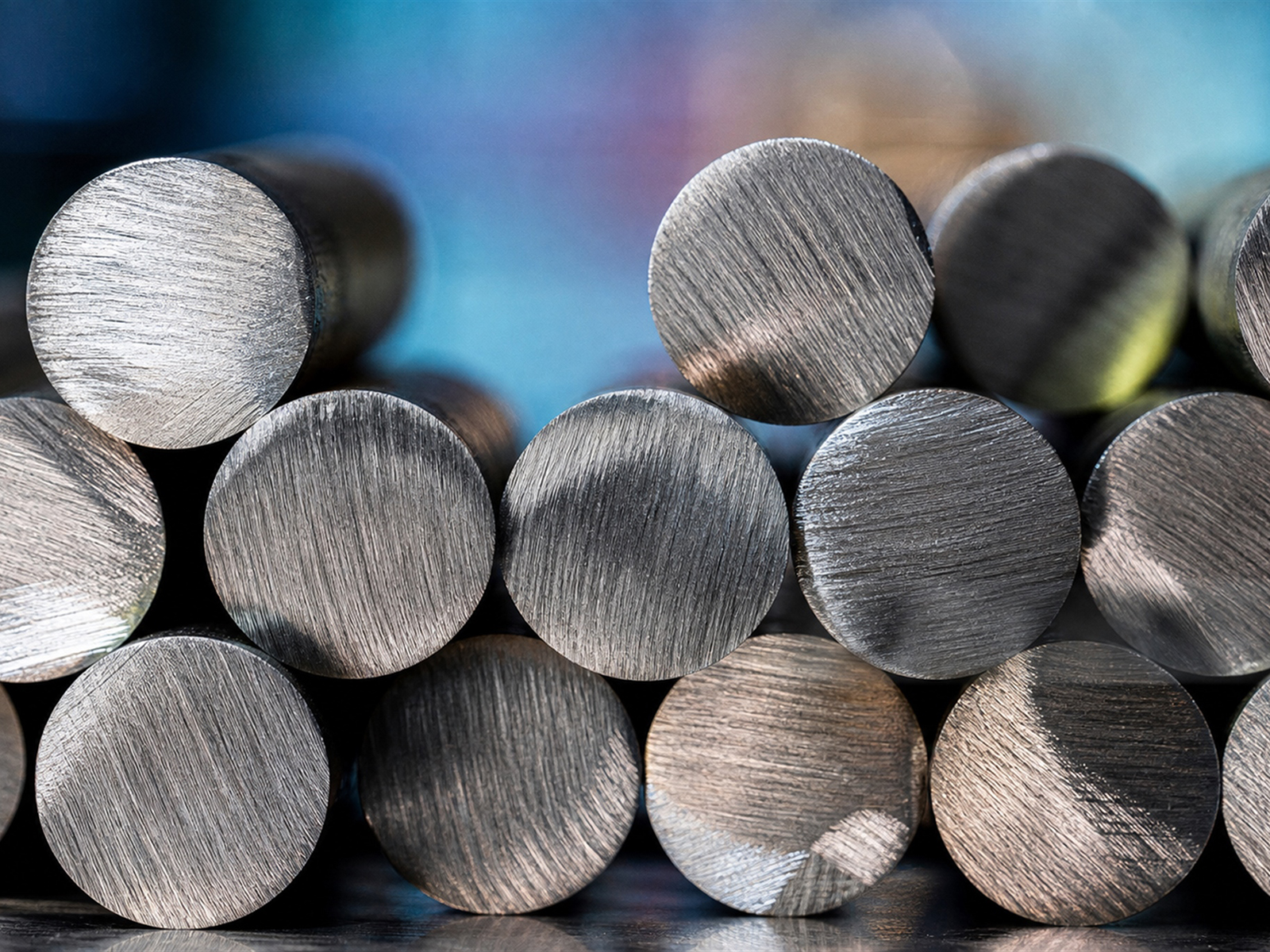
Titanium barstock is raw material for machining and fabrication in round, square or hexagonal sections. Choose the section and grade for the part, then specify the dimensions and surface needed for the first manufacturing operation.
1. Selection and Acceptance Decisions
- Provide the required section shape, across-flats or diameter dimensions and available machining allowance.
- State random or cut lengths, quantity and any saw-cut, deburring or identification requirements.
- Ask the supplier to confirm the quoted form and size instead of assuming every catalog grade is offered in every section.
Send a specification for this material with the grade, dimensions, quantity, intended use and the acceptance details listed above. Ask for confirmation of the quoted size, condition and documentation.
2. What Titanium Barstock Is
The word “barstock” is shop-floor language for bar product bought as raw material for machining, as opposed to finished parts. In ASTM terms the governing document is B348, which covers bar (round, square, hex or other shapes) and billet. Barstock arrives in random lengths of roughly 300–3, 000 mm (annealed) or up to ~6, 000 mm (hot-worked), with square and hex sections typically from 6×6 to 80×80 mm.
3. Grades at a Glance
Grade | UNS | Tensile (min) | Yield (min) | Elongation (min) | Character |
Grade 1 | R50250 | ≥ 240 MPa | 170–310 MPa | 24% | Purest CP, best formability |
Grade 2 | R50400 | ≥ 345 MPa | ≥ 275 MPa | 20% | CP workhorse, best cost-performance |
Grade 4 | R50700 | ≥ 550 MPa | ≥ 483 MPa | 15% | Strongest CP grade |
Grade 5 | R56400 | ≥ 895 MPa | ≥ 828 MPa | 10% | Ti-6Al-4V, α+β workhorse |
Grade 9 | R56320 | ≥ 620 MPa | ≥ 483 MPa | 15% | Ti-3Al-2.5V, cold-formable alloy |
Grade 12 | R53400 | ≥ 483 MPa | ≥ 345 MPa | 18% | Ti-0.3Mo-0.8Ni, crevice-corrosion resistant |
Table 1 — Annealed minimums per ASTM B348 for the barstock grades most buyers order.
4. How Barstock Is Made
The standard route: high-purity sponge titanium → vacuum arc remelting (VAR), typically two to three melts for composition control → forging/breakdown → hot rolling or precision drawing → annealing → straightening → peeling, turning or grinding → inspection. Large mills run continuous rolling lines (the Titanium Valley line is rated over 20, 000 t/yr) that deliver consistent chemistry and gauge across batch sizes. The melt count and the final surface route are the two quality dials buyers should ask about.
5. Sizes, Tolerances and Surfaces
Route | Diameter range | Tolerance practice | Typical surface |
Cold-drawn / precision | φ4–30 mm | h9 / h10 / h11 bands by diameter | Bright or ground, Ra < 0.8 µm possible |
Hot-rolled + annealed | φ30–100 mm (φ8–200 mm) | Standard rolling tolerance | Pickled (silver-gray, Ra ~3.2–6.3 µm) |
Forged | φ100–300 mm | Agreed per drawing | Black or machined |
Table 2 — The three supply routes and their tolerance and surface character.
Ordering Checklist
- Grade + UNS — e.g., Grade 5 / UNS R56400;
- Diameter + tolerance band — state h9/h10/h11 only together with the diameter and route;
- Length — random length or cut-to-length (cut tolerance agreed in the contract);
- Surface — black, peeled, turned or ground, with Ra where it matters;
- Standard + edition — ASTM B348 (or GB/T 2965), plus AMS 4928/F67/F136 where the industry requires;
- Documentation — MTR with heat number, full chemistry, tensile for the condition, plus NDT where agreed.
6. Where Barstock Goes
Titanium barstock becomes pump and agitator shafts, marine and chemical fasteners, aerospace brackets, medical instrument blanks, valve stems, electrode hangers, spring wire feed stock and precision pins. The grade map is simple: Grade 2 for general corrosion service, Grade 4 where CP strength matters, Grade 5 where strength-to-weight decides, Grade 12 for crevice-corrosion and reducing-acid duty.
FAQ
(1) What is the difference between titanium barstock and billet?
Billet is the larger semi-finished form upstream of bar; B348 covers both, but “barstock” in procurement means bar product ready for machining. Confirm the product form on the order to avoid receiving forging stock when you need finished bar.
(2) Which grades are normally stocked?
Grade 2 and Grade 5 dominate standard stock; Grade 1, 4, 9 and 12 are commonly made to order. Custom size, condition, tolerance and documentation can be reviewed to the purchase specification. Custom size, condition, tolerance and documentation can be reviewed to the purchase specification.
(3) Can square and hex titanium barstock be supplied?
Yes — square and hex sections are standard barstock forms, typically 6×6 to 80×80 mm, cut or drawn per order.
(4) What surface should I order for machining?
Peeled or turned bright bar saves a roughing pass; pickled bar is cheaper where you will machine the whole surface anyway. State the Ra requirement when the part is finished from stock surface.
(5) How do I verify the material is real B348 Grade 2?
Check the MTR: heat number, full chemistry including O and Fe, tensile and elongation for the stated condition, and the standard edition. If any field is blank, query before acceptance.
(6) Does ASTM B348 include NDT by default?
No — ultrasonic or eddy-current testing is a supplementary requirement. Write it into the order where the part is load-bearing or safety-critical.
7. Related Resources and Inquiry
See the titanium rod category for grade-specific pages, or send your specification for a barstock quote.
Baoji Titanium Valley Titanium Nickel Zirconium Material Processing Co., Ltd. produces titanium rod and barstock from VAR-melted ingots on a rolling line rated over 20, 000 t/yr, per ASTM B348 / GB/T 2965, with cold-drawn, hot-rolled and forged routes. Send your specification to sales@titaniumvalleys.com — Custom size, condition, tolerance and documentation can be reviewed to the purchase specification.
8. Related Reading
- Titanium Round Bar: Surface, Straightness and Tolerances
- ASTM B348 Titanium Rod: Specification and MTR Review
References
1. ASTM B348/B348M, Standard Specification for Titanium and Titanium Alloy Bars and Billets.
2. ASTM E8/E8M, Standard Test Methods for Tension Testing of Metallic Materials.
3. GB/T 2965, Titanium and Titanium Alloy Bars.
4. EN 10204, Metallic Products — Types of Inspection Documents.
This article is a technical reference. It does not constitute a commercial offer; dimensions, tolerances and documentation are confirmed at order review.
Published by: Titanium Valley Technical Team. Technical and quality review: pending.