
Grade 2 Titanium Foil: Corrosion Resistance and Properties
- Grade 2 Titanium Foil
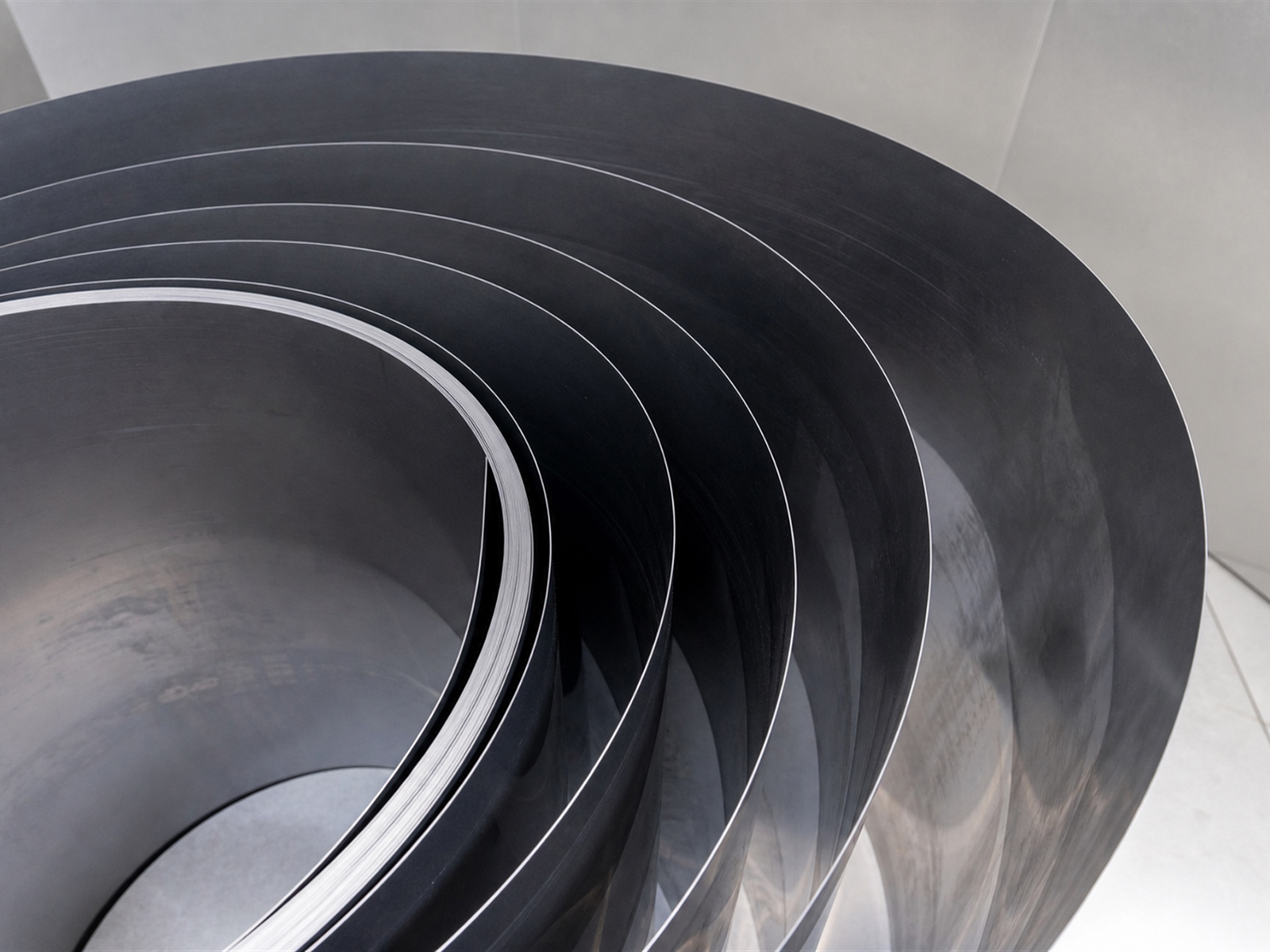
Grade 2 titanium foil combines commercially pure titanium corrosion resistance with higher strength than Grade 1. Evaluate corrosion for the actual medium, concentration, temperature, crevices and contact with other metals before specifying foil. View related foil specifications.
Corrosion conditions to check first
List the process medium, concentration, operating temperature and contaminants. Identify crevices, joints and contact with other metals. Use service-specific compatibility data and confirm whether the finished assembly needs testing.
Chemical Composition
Element (max %) | Grade 2 limit |
Nitrogen (N) | 0.03 |
Carbon (C) | 0.08 |
Hydrogen (H) | 0.015 |
Iron (Fe) | 0.30 |
Oxygen (O) | 0.25 |
Titanium (Ti) | Balance (≥ 99.2%) |
Table 1 — Grade 2 composition limits per ASTM B265.
Mechanical and Physical Properties
Property | Value |
Tensile strength (min) | ≥ 345 MPa (50 ksi) |
Yield strength | 275–450 MPa |
Elongation (min) | 20% |
Density | ≈ 4.51 g/cm³ |
Melting point | ≈ 1668℃ |
Thermal conductivity | ≈ 21 W/(m·K) |
Magnetism | Non-magnetic |
Table 2 — Annealed properties per ASTM B265 and typical physical data.
Corrosion Behavior
Grade 2 titanium foil owes its industrial dominance to passivity: a self-healing TiO₂ film resists oxidizing acids, chlorides and seawater without pitting or crevice attack in most cases, which is why it is the default material wherever stainless steels fail on chlorides. The boundary to remember: hot, strongly reducing acids (concentrated HCl or H₂SO₄) break the film, and those services belong to a different grade family or require an explicit engineering review.
Applications by Thickness Band
Application | Typical thickness | Process | Key requirement |
Li-ion battery current collectors | 0.02–0.03 mm | Precision rolling to the thinnest band | Electrolyte corrosion resistance, mechanical strength, light weight |
EMI shielding foil | 0.05–0.1 mm | Slitting / etching / stamping | Non-magnetic, low density, corrosion resistance |
Coin-cell liners and tabs | 0.03–0.1 mm | Stamping (paired with 0.2–0.5 mm case strip) | Biocompatibility, electrolyte resistance, low contact resistance |
consumer electronics precision shielding and masking parts | 0.03–0.15 mm | Etching, stamping, laser cutting | Thin, hard, temperature-resistant, etchable to micron detail |
Strain-gauge and sensor substrates | 0.02–0.05 mm | Precision rolling of high-purity foil | Fatigue resistance, elastic response, environmental stability |
Table 3 — Foil band (0.02–0.2 mm): precision and micro-forming Grade 2 applications.
Application | Typical thickness | Process | Key requirement |
Hydrogen fuel-cell bipolar plates | 0.1–0.25 mm | Stamping / hydroforming + conductive coating | 40–50% weight reduction vs graphite plates |
PEM electrolyzer bipolar plates | 0.1–0.5 mm | Etched flow fields + noble-metal catalyst coating | Acidic oxygen-evolving environment, conductivity, strength |
Automotive exhaust multilayer gaskets | 0.1–0.2 mm | Stamping | High-temperature oxidation resistance, elastic recovery, vibration tolerance |
Exhaust bellows / EGR ducts | 0.15–0.3 mm | Corrugated forming + hydroforming | High-temperature strength, thermal-stress tolerance, damping |
Heat-exchanger thin-wall tubes and plates | 0.2–0.5 mm | Roll-welded thin-wall tube from strip | Chloride-ion resistance, good heat transfer |
Heat-spreading / vapor-chamber structures | 0.2–0.5 mm | Stamping / forming | Low thermal expansion, high strength, corrosion resistance |
Electroplating anode baskets | 0.3–0.5 mm | Welded forming | Acid-bath stability, stable material retention |
Medical device housings and parts | 0.2–0.5 mm | Stamping / deep drawing | Biocompatible, non-magnetic, sterilization-resistant |
Table 4 — Strip band (0.2–0.5 mm): the energy, automotive and heat-transfer heart of Grade 2 foil.
Application | Typical thickness | Process | Key requirement |
PEM electrolyzer plates and end plates | 0.5–1.0 mm | Machining / etched flow fields + coating | High strength, corrosion resistance, conductivity |
Chemical corrosion-resistant components | 0.5–1.0 mm | Forming / welding | Resistance to acids and chloride media |
Marine / seawater heat exchange and structure | 0.5–1.0 mm | Forming / welding | Seawater corrosion resistance, anti-fouling |
Table 5 — Sheet band (0.5–1.0 mm): structural, chemical and marine Grade 2 parts.
1. Deep Dive: Hydrogen fuel-cell bipolar plates
Hydrogen fuel-cell bipolar plates are stamped or hydroformed from 0.1–0.25 mm strip into flow-field plus separator plates, then given a conductive coating. Titanium plates cut stack weight by 40–50% against graphite plates and survive the acidic, humid cell environment — the mainstream direction for automotive fuel cells. Grade 2 supplies the forming margin the stamped flow channels need.
2. Deep Dive: PEM electrolyzer bipolar plates
In PEM water electrolyzers the anode operates in a strongly acidic, oxygen-evolving environment that attacks most metals. Titanium plates (0.1–0.5 mm for bipolar plates, 0.5–1.0 mm for end plates and supports) are etched with flow fields and coated with noble-metal catalysts to support the membrane electrode assembly and direct hydrogen and oxygen flow — a core component of green-hydrogen systems.
3. Deep Dive: Heat-exchanger thin-wall tubes and plates
Thin-wall heat-exchanger tubes are roll-formed and welded from 0.2–0.5 mm strip for seawater and chlorinated duty: desalination, power-plant and chemical condensers. Titanium’s total life cost beats copper-nickel in these services, and Grade 2’s weldability is what makes reliable thin-wall tube production possible.
4. Deep Dive: Automotive exhaust multilayer gaskets
Exhaust manifold and turbocharger interface gaskets stamped from 0.1–0.2 mm strip keep elasticity and seal integrity at exhaust temperatures through thermal cycling and vibration — the failure modes that retire stainless-steel multilayer gaskets early. Companion exhaust bellows (0.15–0.3 mm, corrugated or hydroformed) absorb thermal expansion in EGR and flex lines.
5. Deep Dive: Li-ion battery current collectors
At 0.02–0.03 mm, Grade 2 foil serves as the current collector in high-voltage cathode battery systems where aluminum foil corrodes: titanium keeps electrochemical stability in aggressive electrolytes, raising cycle life and safety. The same band supplies EMI shielding, coin-cell liners and strain-gauge substrates.
Standards and Variants
Grade 2 foil is ordered to ASTM B265; aerospace practice adds AMS 4902, and the medical parallel is ASTM F67 Grade 2 (ISO 5832-2). Equivalent designations: UNS R50400, DIN 3.7035, JIS Class 2, Chinese TA2. See the Grade 2 titanium foil product page and the AMS 4902 Gr2 product page.
FAQ
(1) What is the difference between Grade 1 and Grade 2 titanium foil?
Grade 2 is about 40% stronger (≥ 345 MPa vs ≥ 240 MPa) with slightly less ductility (≥ 20% vs ≥ 24%). Choose Grade 1 for deep drawing, Grade 2 for parts that need structural support, welding or the best cost-performance.
(2) Can Grade 2 titanium foil be welded?
Yes — it is one of the most weldable titanium grades. TIG and laser welding with full inert-gas shielding produce sound joints; this is what makes 0.2–0.5 mm roll-welded heat-exchanger tube stock practical.
(3) Which Grade 2 applications are growing fastest?
Fuel-cell bipolar plates, PEM electrolyzer plates and battery current collectors — the new-energy applications where corrosion resistance and light weight decide lifetime economics.
(4) What is the maximum service temperature of Grade 2 foil?
A practical rule of thumb is continuous structural service up to roughly 150–300℃ depending on environment, load and surface condition. Confirm the ceiling for the real application rather than applying a single number.
(5) Which thickness is used for battery and fuel-cell applications?
0.02–0.03 mm for current collectors, 0.1–0.25 mm for fuel-cell bipolar plates and 0.1–0.5 mm for electrolyzer plates; the exact gauge is confirmed at order review against the cell design.
(6) Can Grade 2 foil be etched?
Yes — consumer electronics shielding parts and precision etched components are produced from 0.03–0.15 mm foil with micron-level detail and burr-free edges.
(7) Which documents should accompany Grade 2 foil?
An MTR with heat number, full chemistry including O/N/H, tensile and elongation for the correct thickness band, delivery condition and standard edition — plus CoC, RoHS and ISO certificates where the industry requires them.
(8) What width is available?
Widths to 680 mm across the 0.02–1.0 mm program; non-standard widths and tolerances are quoted as purchase-specification items. Custom size, condition, tolerance and documentation can be reviewed to the purchase specification.
Related Resources and Inquiry
Compare grades in the titanium foil category or review the ASTM B265 grade selection guide. Ready to order? Send your specification.
Baoji Titanium Valley Titanium Nickel Zirconium Material Processing Co., Ltd. operates a 750 mm 20-high titanium foil line (3, 000 t/yr, ISO 9001 / ISO 13485) covering the full 0.02–1.0 mm range with etching, stamping and welding compatibility. Send your specification to sales@titaniumvalleys.com — Custom size, condition, tolerance and documentation can be reviewed to the purchase specification.
References
1. ASTM B265, Standard Specification for Titanium and Titanium Alloy Strip, Sheet, and Plate.
2. ASTM F67, Standard Specification for Unalloyed Titanium, for Surgical Implant Applications.
3. ASTM E8/E8M, Standard Test Methods for Tension Testing of Metallic Materials.
4. SAE AMS 4902, Titanium Sheet, Strip, and Plate, Commercially Pure, Annealed, 40.0 ksi (276 MPa) Yield Strength.
5. ISO 5832-2, Implants for Surgery — Metallic Materials — Unalloyed Titanium.
6. Baoji Titanium Valley: 0.02–1.0 mm Titanium and Titanium Alloy Strip and Foil — Application Introduction (internal application deck).
7. Titanium Valley product data: Gr2 Titanium Foil and AMS 4902 Gr2 product pages (titaniumvalleys.com).
This article is a technical reference. It does not constitute a commercial offer; dimensions, tolerances and documentation are confirmed at order review.
Published by: Titanium Valley Technical Team. Technical and quality review: pending.