
What Are the Chemical Composition and Material Properties of Gr5 Titanium Wire?
- Gr5 titanium wire
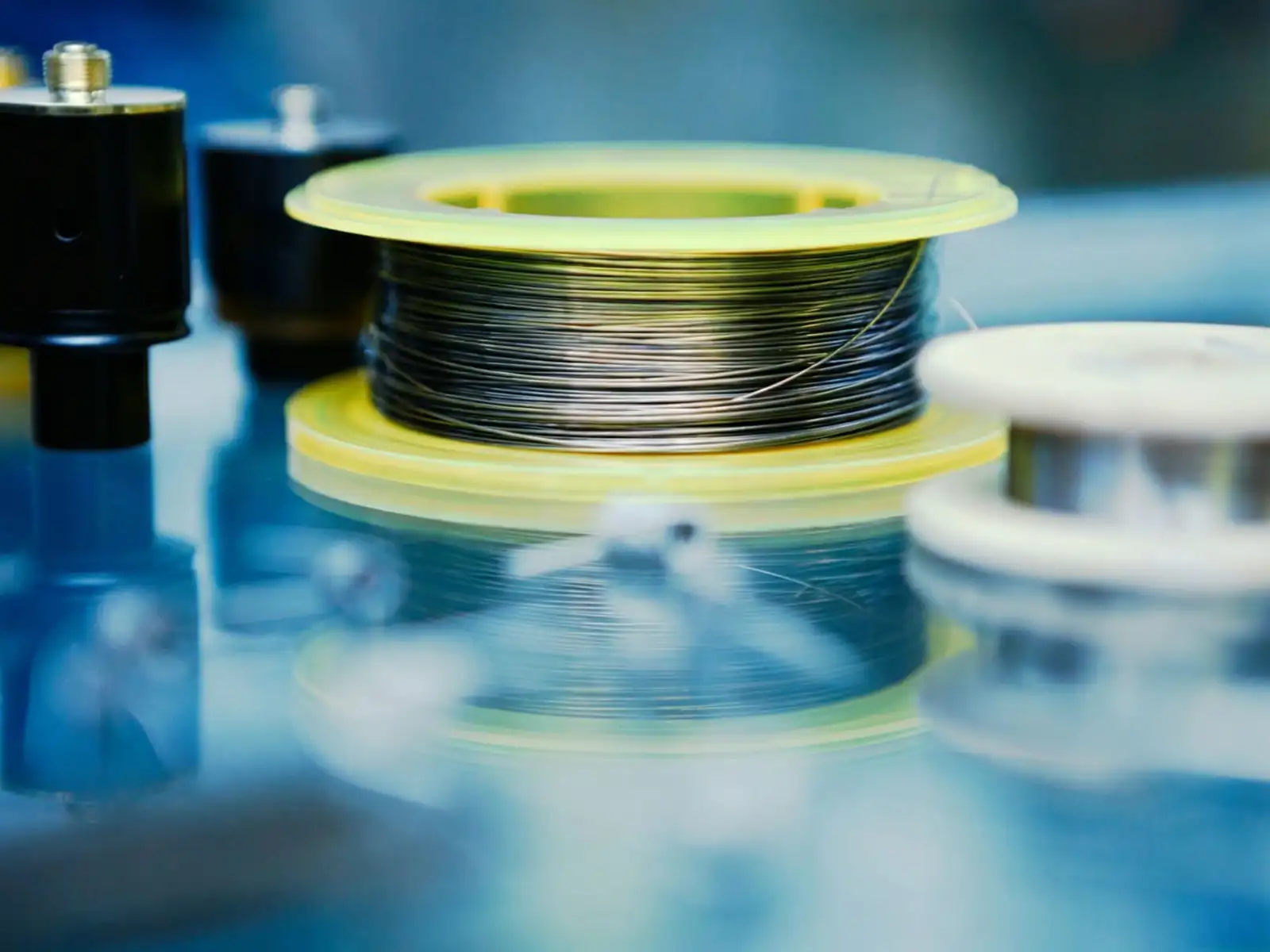
Direct engineering answer. Gr5 titanium wire should be evaluated against the finished component, product form, governing specification, downstream process and acceptance evidence. A general property value is an orientation tool; the released drawing, current certificate and inspection plan control the final decision.
Gr5 titanium wire (Ti-6Al-4V) is one of the most widely used α+β duplex titanium alloy wires. Its nominal chemical composition is titanium (balance), aluminum (5.5%–6.75%), and vanadium (3.5%–4.5%), with strictly controlled impurity elements including iron, oxygen, carbon, nitrogen, and hydrogen. This alloy design yields a combination of properties with a density of approximately 4.51 g/cm³ and a typical annealed tensile strength of not less than 895 MPa. Compared with commercially pure titanium, its strength is approximately doubled; compared with common steels, its density is approximately 43% lower. Gr5 titanium wire is an important candidate material in aerospace, medical devices, chemical processing equipment, and precision electronics, but specific selection must be evaluated based on product standards, supply condition, and service conditions and should not be loosely described as “irreplaceable.”
1. Chemical Composition and Standard Basis of Gr5 Titanium Wire
(1) Main Alloying Elements: The Synergistic Role of Aluminum and Vanadium
Aluminum (Al) is an α-phase stabilizer, typically present at 5.5%–6.75%. The addition of aluminum increases alloy strength and elastic modulus while reducing density, which benefits lightweight design. Vanadium (V) is a β-phase stabilizer, typically present at 3.5%–4.5%, improving hot workability and ductility and reducing the tendency to crack during cold drawing. The balance of aluminum and vanadium gives Gr5 a stable α+β duplex microstructure combining strength, toughness, and workability.
(2) Control of Impurity Elements and Its Standard Basis
The table below lists the common maximum impurity element limits for conventional industrial-grade Gr5/Ti-6Al-4V wire, mainly to illustrate the significance of metallurgical control. In actual purchasing, the specific standard number and edition must be followed, because different ASTM, AMS, and GB/T standards differ in their limits for elements such as iron and oxygen.
Element | Common Maximum Limit | Significance of Control |
Fe (Iron) | ≤0.30% | Excessive iron content promotes β-phase segregation and affects fatigue properties |
O (Oxygen) | ≤0.20% | Oxygen provides significant solid-solution strengthening, but exceeding the limit reduces ductility and toughness and increases notch sensitivity |
C (Carbon) | ≤0.08% | Excessive carbon may form carbides and affect toughness |
N (Nitrogen) | ≤0.05% | Nitrogen is a strong solid-solution strengthening element; excessive amounts increase notch sensitivity |
H (Hydrogen) | ≤0.015% | Hydrogen-induced embrittlement is a high-risk failure mode for titanium alloys |
Particular attention is required: the oxygen ≤0.20% and iron ≤0.30% in the table are common limits for conventional industrial-grade Gr5 and cannot automatically be equated with medical-grade requirements. Ti-6Al-4V ELI for surgical implants should be executed per ASTM F136 or GB/T 13810, whose stricter requirements include oxygen ≤0.13% and iron ≤0.25%. Therefore, conventional Gr5 cannot be broadly stated to satisfy ASTM F136.
Hydrogen control is especially critical. Excessive hydrogen content can form brittle hydride phases in the microstructure, causing delayed cracking. Vacuum arc remelting or cold hearth melting is a common technical means of reducing hydrogen content and keeping it below 0.015%.
(3) Effect of Composition Uniformity on Batch Consistency
Chemical composition control is not only about meeting numerical values but also about uniformity between batches. Non-uniform melting can cause local composition segregation, manifesting as batch-to-batch variation in wire mechanical properties. Vacuum arc remelting combined with multiple remelts can keep composition deviation within a small range and improve the property consistency of Gr5 titanium wire across different batches.
2. Physical and Mechanical Properties of Gr5 Titanium Wire
(1) Key Physical Parameters
Physical Property | Typical Value and Test Conditions |
Density | 4.51 g/cm³ (room temperature) |
Melting Range | Approximately 1604–1660℃, solidus approximately 1604℃ |
Elastic Modulus | Approximately 110 GPa (room temperature) |
Coefficient of Thermal Expansion | 8.6×10⁻⁶/°C (20–100℃) |
Thermal Conductivity | Approximately 6.7 W/(m·K) (room temperature) |
Electrical Resistivity | Approximately 1.7×10⁻⁶ Ω·m, i.e., 170 μΩ·cm (room temperature) |
Magnetic Properties | Non-ferromagnetic under normal conditions |
Note: The above are typical engineering reference values; actual values are affected by composition, heat treatment condition, test temperature, and method. Expressed in SI units, the resistivity is approximately 1.7×10⁻⁶ Ω·m, equivalent to 170 μΩ·cm, to avoid the misreading caused by writing “1.7 μΩ·m.”
Gr5 titanium wire has a density of only approximately 57% of common steels. Its low thermal conductivity gives it design value in applications requiring lower heat transfer, and its non-magnetic nature is an important compatibility condition for some medical devices and precision instruments.
(2) Mechanical Properties and Their Relation to Condition
The mechanical properties of Gr5 titanium wire are significantly affected by supply condition, wire diameter, and test standard. Common supply conditions are annealed and cold worked. The annealed condition generally offers good ductility and toughness, suitable for subsequent cold working, bending, or welding; the cold-worked condition is obtained by cold deformation of the annealed material, with significantly higher strength but reduced ductility and toughness, suitable for elastic components and high-strength fasteners. In industry, “annealed + cold worked” is not an independent equilibrium state separate from the annealed and cold-worked conditions; cold working after annealing is simply the cold-worked condition. If an intermediate balance between strength and ductility is required, it should be achieved by specifying the cold working reduction, final annealing temperature, or specific mechanical property ranges.
Typical mechanical property reference values (annealed condition, medium-diameter wire or bar, measured per GB/T 228.1 or ASTM E8):
- Tensile strength: ≥895 MPa
- Yield strength (0.2%): ≥828 MPa
- Elongation: ≥10%
- Reduction of area: ≥25%
It should be noted that reduction of area is sensitive to diameter and condition. The reduction of area of fine wire and the cold-worked condition may be lower than the above values and cannot be applied universally to all wire diameters. Purchasing and application should be based on the corresponding product standard, diameter range, and material test certificate.
(3) Corrosion Resistance and Boundary Conditions
Gr5 titanium wire has good corrosion resistance in oxygen-containing, near-neutral chloride environments, seawater, and many oxidizing acidic media. Its corrosion resistance comes from the self-forming dense TiO₂ passive film on the surface, which can heal relatively quickly in oxygen-containing media after damage. However, it must be emphasized: titanium alloys are not corrosion-resistant in strongly reducing acids (such as hydrochloric acid and sulfuric acid at higher concentrations), and temperature, concentration, flow rate, and the presence or absence of oxygen all significantly affect corrosion behavior. Therefore, it is inappropriate to broadly state that the material “performs excellently in acid-base media across pH 2–14.” Compared with 316L stainless steel, Gr5 titanium wire generally performs better in pitting and crevice corrosion scenarios involving chloride ions and near-neutral conditions, which helps extend maintenance intervals. However, the service-life advantage must be qualified by chloride concentration, temperature, pH, flow rate, and structural crevice conditions, and an unconditional multiplicative relationship cannot be given.
3. Relationships Among Composition, Microstructure, and Properties
(1) Aluminum and Specific Strength
Aluminum raises the strength of the α phase through solid-solution strengthening while slightly reducing alloy density, making it attractive for aerospace and lightweight design. However, the strength increment is jointly affected by aluminum content, microstructural condition, and processing technology, and fixed empirical values such as “each additional 1% aluminum increases strength by approximately 40–50 MPa” should not be cited. Engineering evaluation should be based on specific batch data or the composition ranges and corresponding properties specified in standards.
(2) Vanadium and the Hot Working Window
As a β-phase stabilizer, vanadium widens the plastic working window at elevated temperatures. In multi-pass cold drawing, the intermediate annealing process design must account for the effect of vanadium content on the β transus temperature. When vanadium content is low, the material may work-harden too quickly during drawing, increasing the risk of wire breakage and reducing yield.
(3) The Strength–Toughness Trade-off of Oxygen
Oxygen is a strong interstitial solid-solution strengthening element; a moderate amount of oxygen increases strength. However, when oxygen content exceeds the standard limit or when local segregation or surface contamination occurs, the main risks are reduced ductility and toughness, increased notch sensitivity, and shortened fatigue life, rather than the precipitation of titanium oxide inclusions once oxygen exceeds 0.20%. Vacuum melting and argon shielding should be used during melting and processing to control oxygen content. Vacuum packaging or inert-atmosphere packaging of finished products is mainly intended to reduce surface contamination, discoloration, and mechanical damage; it has no direct causal relationship with long-term control of internal oxygen and hydrogen content and should not be regarded as an “indispensable” control measure.
4. Typical Application Scenarios and Material Selection Logic for Gr5 Titanium Wire
(1) Aerospace and Defense
The aerospace industry prioritizes lightweight, high strength, and reliability. Gr5 titanium wire can be used for engine casing welding filler wire, hydraulic tubing, and high-strength fasteners. Welding filler wire should match the composition of the Ti-6Al-4V base metal so that weld properties are not lower than design values. Aerospace purchasing should specify the editions and product forms of standards such as AMS 4955 and AMS 4928, rather than judging a wire to be “aerospace-grade titanium wire” based on grade designation alone. AMS 4928 does not cover only wire; it also covers bar, wire, forgings, rings, and other forms.
(2) Medical Devices and Precision Electronics
The medical field focuses on biocompatibility and non-magnetic properties. For implants or devices in long-term contact with the human body, the low-interstitial-element version Ti-6Al-4V ELI should be selected and ordered per ASTM F136 or GB/T 13810, with oxygen ≤0.13% and iron ≤0.25%. Conventional Gr5 (oxygen ≤0.20%, iron ≤0.30%) does not automatically satisfy medical ELI requirements. Precision electronics and premium consumer products focus more on fine-diameter machining precision and surface finish. Fine wire can be processed down to φ0.1 mm, but this must be evaluated in combination with diameter tolerance, surface condition, elasticity, and fatigue requirements.
(3) Chemical and Marine Engineering
In seawater or chloride environments with high chloride content, near-neutral pH, and oxygen present, Gr5 titanium wire generally offers better resistance to pitting and crevice corrosion than 316L stainless steel and can be used for pump shafts, valve stems, and heat exchanger fittings. However, in strongly reducing acids and high-temperature, high-concentration acidic environments, Ti-6Al-4V should be avoided. Material selection should be based on a comprehensive evaluation of the specific media, temperature, concentration, flow rate, and life-cycle cost.
5. Quality Control and Inspection System for Gr5 Titanium Wire
(1) Key Process Stages From Bar Stock to Finished Wire
Gr5 titanium wire production process chain is typically: bar stock selection → peeling/pickling → multi-pass cold drawing (including intermediate annealing) → final annealing → pickling/polishing → precision straightening → finished-product inspection → clean packaging. Multi-pass cold drawing is the core stage for controlling wire dimensional precision and mechanical properties. The reduction per pass must be designed based on the work-hardening rate; too large a reduction causes wire breakage, while too small a reduction reduces production efficiency.
(2) Comprehensive Inspection Program System
Inspection Category | Specific Items |
Chemical Composition | ICP spectrometric full-element analysis, per GB/T 3620.1 and other standards |
Mechanical Properties | Tensile, hardness, and fatigue testing, per GB/T 228.1 or ASTM E8 and other standards |
Dimensional Precision | Wire diameter, ovality, straightness |
Non-destructive Testing | Ultrasonic testing for bar stock or large-diameter material; eddy current testing for finished fine wire, as per product specifications and agreement |
Surface Quality | Surface finish, oxide layer, and visual defect inspection |
Metallographic Microstructure | α+β phase ratio, grain size |
Corrosion Resistance | Salt spray testing, electrochemical polarization curves |
(3) Applicable Standards and Certification System
Gr5 titanium wire should be supplied to the applicable standard based on product form and application scenario: general industrial wire per GB/T 3623 or ASTM B863; welding wire per AWS A5.16 or GB/T 30562; surgical implant applications per ASTM F136 or GB/T 13810. For aerospace wire or bar, AMS 4955 and AMS 4928 may be referenced, but AMS 4928 also covers bar, wire, forgings, rings, and other forms and cannot simply be described as the “aerospace-grade titanium wire standard.” Regarding EN 10204: an EN 10204 3.1 certificate is a manufacturer’s quality assurance document certifying that the product meets contractual or standard requirements; it is not equivalent to an endorsement by a third-party inspection body. If third-party witnessing or inspection is required, EN 10204 3.2 should be agreed or the third-party witnessing items clearly specified. A complete quality documentation chain with traceability from incoming raw material to finished-product shipment is especially critical for aerospace and medical device procurement.
6. Conclusion
Through the compositional design of the Ti-6Al-4V alloy, Gr5 titanium wire achieves a high degree of engineering balance among strength, corrosion resistance, lightweighting, and workability. From chemical composition control, to the engineering expression of physical and mechanical properties, to full-process quality management, every stage should be evaluated against specific standards and service conditions. For manufacturers pursuing reliability and traceability, understanding the boundary conditions of these properties is more important than memorizing a single value.
FAQ
(1) Q1: What Is the Core Difference in Chemical Composition Between Gr5 Titanium Wire and Commercially Pure Titanium Wire (Gr1/Gr2)?
Gr5 contains 5.5%–6.75% aluminum and 3.5%–4.5% vanadium, forming an α+β duplex microstructure with higher strength than commercially pure titanium. Commercially pure titanium wire contains almost no alloying elements; it has better ductility but lower strength and is suitable for low-load, high-formability applications.
(2) Q2: What Practical Problems Occur When the Hydrogen Content of Gr5 Titanium Wire Exceeds the Limit?
When hydrogen content exceeds 0.015%, brittle hydride phases may form inside the titanium alloy, leading to delayed hydrogen embrittlement cracking. In elastic components and welding wire applications, hydrogen embrittlement may cause fracture without warning. Vacuum melting is a common technical means of controlling hydrogen content; vacuum packaging is mainly for surface protection and is not the key measure for controlling internal hydrogen content.
(3) Q3: How Can You Determine Whether Gr5 Titanium Wire Meets Aerospace or Medical Procurement Requirements?
For aerospace applications, the product form should be specified and the editions of standards such as AMS 4955 and AMS 4928 verified, with EN 10204 3.1/3.2 and traceability documents required. For medical applications, Ti-6Al-4V ELI should be selected and ordered per ASTM F136 or GB/T 13810. General industrial wire is per GB/T 3623 or ASTM B863, and welding wire per AWS A5.16 or GB/T 30562. When purchasing, the standard number, edition, supply condition, wire diameter, property requirements, and acceptance conditions should be stated.
Contact Us
Looking for a reliable manufacturer, supplier, or processing service provider for Gr5 titanium wire (Ti-6Al-4V, UNS R56400)? A professional titanium materials company with full-process capability from bar stock selection, peeling/pickling, multi-pass cold drawing (including intermediate annealing), and final annealing through pickling/polishing, precision straightening, and finished-product inspection can supply in accordance with GB/T 3623, ASTM B863, AWS A5.16, GB/T 30562, and other standards, covering both industrial and medical grades (Ti-6Al-4V ELI, ASTM F136/GB/T 13810), with annealed tensile strength ≥895 MPa, yield strength ≥828 MPa, and elongation ≥10%, and fine wire processable down to φ0.1 mm. It can provide EN 10204 3.1/3.2 certificates, ICP full-element chemical composition analysis, tensile/hardness/fatigue property reports, wire diameter and ovality inspection, eddy current or ultrasonic inspection reports, metallographic microstructure data (α+β phase ratio, grain size), and corrosion data such as salt spray and electrochemical polarization curves, and can supply in accordance with aerospace specifications such as AMS 4955 and AMS 4928. Please contact: sales@titaniumvalleys.com
References
- Standardization Administration of China. GB/T 3620.1—2016 Designation and composition of titanium and titanium alloys [S]. Beijing: Standards Press of China, 2016.
- Standardization Administration of China. GB/T 3623—2007 Titanium and titanium alloy wire [S]. Beijing: Standards Press of China, 2007.
- Standardization Administration of China. GB/T 13810—2017 Wrought titanium and titanium alloy products for surgical implants [S]. Beijing: Standards Press of China, 2017.
- Standardization Administration of China. GB/T 228.1—2010 Metallic materials — Tensile testing — Part 1: Method of test at room temperature [S]. Beijing: Standards Press of China, 2010.
- Standardization Administration of China. GB/T 6611—2008 Terminology of titanium and titanium alloys [S]. Beijing: Standards Press of China, 2008.
- Zhang Xiyan, Zhao Yongqing, Bai Chenguang. Titanium Alloys and Applications [M]. Beijing: Chemical Industry Press, 2005.
Engineering specification and verification framework
For Gr5 titanium wire, state grade, ordered product form, condition, nominal dimensions, tolerances, surface requirement, quantity and documentation in one controlled RFQ. The applicable product-form reference is ASTM B863, subject to the current edition and project-specific requirements. When tensile evidence is required, define the test method and sampling basis; ASTM E8/E8M or ISO 6892-1 may apply where consistent with the order.
| RFQ field | Required detail | Reason |
|---|---|---|
| Material identity | Grade, form, ASTM B863, condition | Prevents unintended substitution. |
| Geometry | Nominal size, tolerance, length or coil form | Defines production and inspection scope. |
| Process context | Forming, machining, joining, etching or assembly | Relates supply condition to actual manufacture. |
| Verification | Certificate, dimensional checks, lot identity | Creates a traceable acceptance plan. |
Risk review and incoming control
Common avoidable risks include tolerance stack-up, unclear condition, surface damage, undocumented substitution and loss of lot identity after cutting. At receipt, reconcile the purchase order, packing label and certificate before release to production. Define any supplementary testing, sampling and report format before quotation rather than after shipment.
Technical FAQ
Can catalogue values approve the material?
No. Final approval must use the ordered form, condition, standard, drawing, process route and service boundary.
What should an RFQ include?
Provide the drawing where available, grade and standard, dimensions, tolerance, condition, quantity, process context, service information and documentation requirement.
Product resources and technical quotation
Review the relevant titanium wire product category. For a drawing-based review, request a technical quotation with the full specification.
References and use note
- ASTM B863, applicable edition, for the ordered product form.
- ASTM E8/E8M or ISO 6892-1 where the project specifies tensile verification.
- Project drawing, purchase specification, certificate and agreed inspection plan.
This engineering note supports procurement specification. It does not replace component design validation or the governing contractual standard.